
Deborah Schamoni presents a curated dialogue between Maria VMier and Nicole Wermers—two artists whose practices diverge formally yet converge through subversive strategies grounded in feminist positions.
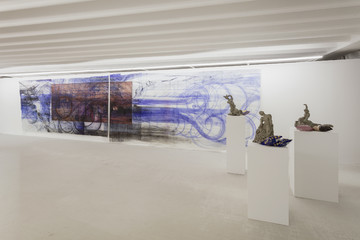
Nicole Wermers is among the most influential sculptors of her generation. Her work operates through fragile, precisely articulated disruptions that probe contemporary sculpture. Positioned between fine and applied art, her sculptures expose social and aesthetic codes embedded in everyday objects and hierarchies of materials.
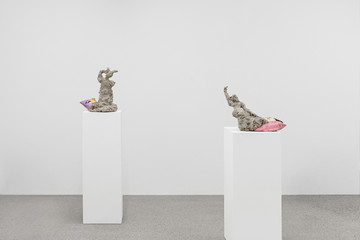
Installation view, Nicole Wermers, Italics, Deborah Schamoni, 2025
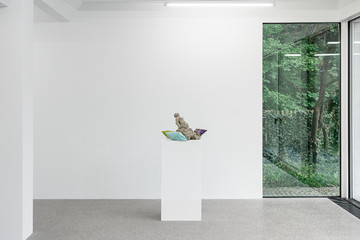
Installation view, Nicole Wermers, Italics, Deborah Schamoni, 2025
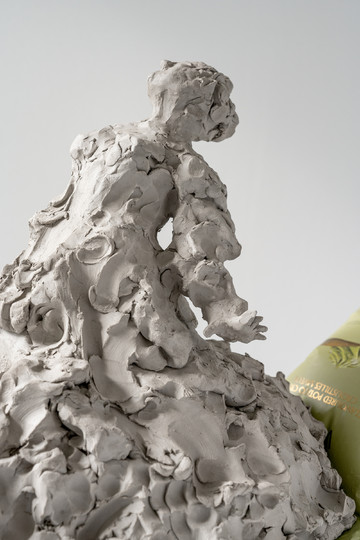
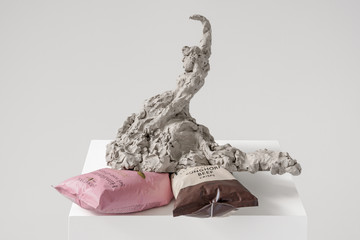
Nicole Wermers, Fainter on posh crisps (Wasabi, Black Garlic & Sour Cream, Salt & Vinegar) (detail), 2025, Reinforced airdry clay, crisp bags, cotton wool, 35 × 45 × 68 cm
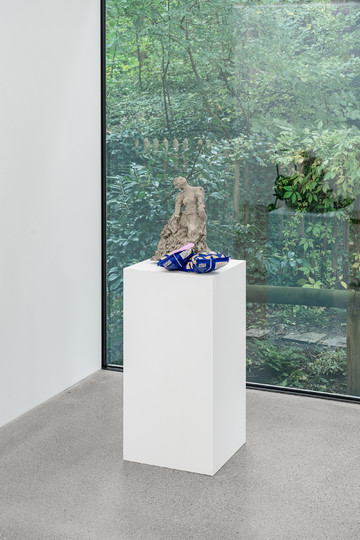
Installation view, Nicole Wermers, Italics, Deborah Schamoni, 2025
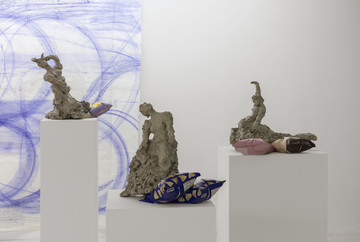
Fainter on posh crisps is a series of clay sculptures of female figures in voluminous dresses, standing on bags of crisps, seemingly frozen in the moment of fainting, in descent towards the ground.
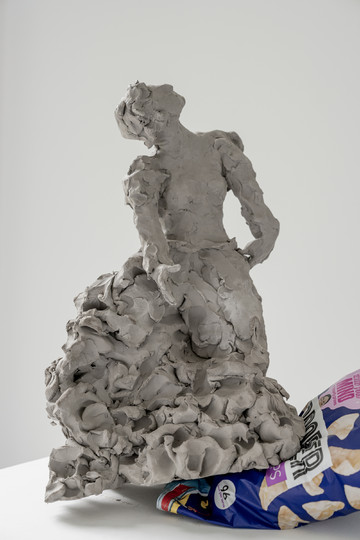
Nicole Wermers, Fainter on posh crisps (Sea Salt, Lentil) (detail), 2025, Reinforced airdry clay, crisp bags, cotton wool, 42,5 x 46 x 41 cm
In the Fainter on posh crisps series, which was created for Wermers exhibition Italics at Deborah Schamoni, the variously inclined clay figures form assemblages in combination with a wide variety of crisps bags. In the United Kingdom, unconventionally flavoured snacks are referred to as ‘posh crisps’ in contrast to the tried-and-tested salt and vinegar variety originally associated with the working class. The flavours of ‘posh crisps’ themselves allude to exoticism and the lifestyles of the supposedly higher social classes, and include Pink Himalayan Salt, Asparagus, Balsamic and Truffle, for example. In 1979, French sociologist Pierre Bourdieu stated in his essay, Distinction, that the purchase of a product is never just an individual decision, but always also an expression of habitus, social field and the pursuit of distinction. Posh crisps thus combine taste that is both ‘discriminating’ (bourgeois with a focus on aesthetics, style, and exclusivity) and ‘pretentious’ (oriented towards social advancement, imitating more sophisticated styles and practices, in an often slightly exaggerated or apparently inauthentic manner, because not anchored in the consumer’s own social background). Whilst the target group for posh crisps includes the traditional upper class, they are also aimed at hipsters with a penchant for social advancement and members of the working class who want to treat themselves to something nice now and again.
In Fainter on posh crisps, inflated crisp packets repeatedly amplify the exaggerated tectonic torsional moments created in the rotation of the figures, simultaneously having both a stabilising and destabilising effect. Compositionally, the inflated skirts also mirror the forms produced by the packets. Both types of voluminous inflation reinforce the drama inherent in the act of falling unconscious – a powerful gesture, which, when performed consciously and theatrically, ensures that all eyes are on it, whilst, at the same time, involving a withdrawal from the situation.
Wermers also alludes to the claims to surrounding space in art history’s preoccupation with inclination and collapsing bodies, ranging from Bernini’s Ecstasy of Saint Theresa, to the diagonals in Medardo Rosso and Auguste Rodin’s sculpture, to Wilhelm Lehmbruck’s tilted heads and Edward Steichen’s photography, which is full of inclined forms.
Text (excerpt): Anna-Catharina Gebbers
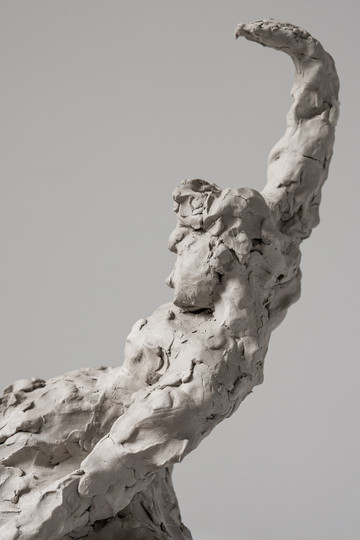
Nicole Wermers, Fainter on posh crisps (Himalayan Salt, Berwick Longhorn Beef) (detail), 2025 Reinforced airdry clay, armature, crisp bags, cotton wool, 43 × 49 × 61 cm
‘What interests me in the idea of fainting is how fake it was, and how it became
a fashion. Very few people have seen someone faint, but we all have an idea of how it looks – this completely fabricated gesture we’ve seen on stage and in films.’
Nicole Wermers
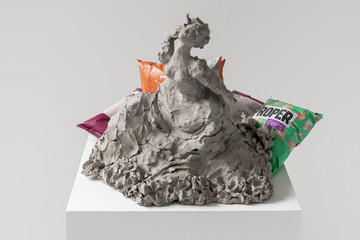
Nicole Wermers, Fainter on posh crisps (Wasabi, Black Garlic & Sour Cream, Salt & Vinegar), 2025 Reinforced airdry clay, crisp bags, cotton wool, 35 × 45 × 68 cm
![Maria VMier, Conditions and Variables Tisch Tisch Bedingungen des Arbeitens Im Gehen [cut], 2024-26, Ink, pigment, acrylic, micaceous iron oxide, and vinyl on paper, 230 × 925 cm - © Paris Internationale](https://parisinternationale.com/media/pages/artfairs/2026-milan/exhibitors/deborah-schamoni/764fa2eb8b-1776497900/0g7a0758-360x.jpg)
Maria VMier, Conditions and Variables Tisch Tisch Bedingungen des Arbeitens Im Gehen [cut], 2024-26, Ink, pigment, acrylic, micaceous iron oxide, and vinyl on paper, 230 × 925 cm
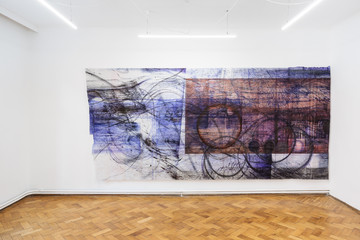
Installation view, Maria VMier, Loggia, Vienna, 2026
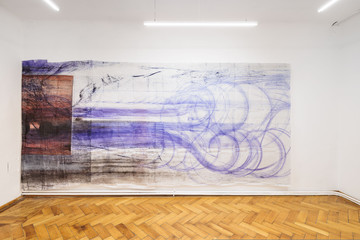
Installation view, Maria VMier, Loggia, Vienna, 2026
Maria VMier’s large-scale drawings push abstraction to its limits. Her spectral mark-making oscillates between the raw and the delicate, evoking bodies in perpetual motion. Through an insistently physical approach, VMier transforms abstraction into a site for examining embodied knowledge, desire, and socio-political relations from a feminist perspective.
![Maria VMier, Conditions and Variables Tisch Tisch Bedingungen des Arbeitens Im Gehen [cut] (detail), 2024-26, Ink, pigment, acrylic, micaceous iron oxide, and vinyl on paper, 230 × 925 cm - © Paris Internationale](https://parisinternationale.com/media/pages/artfairs/2026-milan/exhibitors/deborah-schamoni/ed383c4027-1775836660/2026-01-19-loggia-loggia-000401-360x.jpg)
Maria VMier, Conditions and Variables Tisch Tisch Bedingungen des Arbeitens Im Gehen [cut] (detail), 2024-26, Ink, pigment, acrylic, micaceous iron oxide, and vinyl on paper, 230 × 925 cm
![Maria VMier, Conditions and Variables Tisch Tisch Bedingungen des Arbeitens Im Gehen [cut] (detail), 2024-26, Ink, pigment, acrylic, micaceous iron oxide, and vinyl on paper, 230 × 925 cm - © Paris Internationale](https://parisinternationale.com/media/pages/artfairs/2026-milan/exhibitors/deborah-schamoni/5fe13f9418-1776289274/2026-01-19-loggia-loggia-000385-full-360x.jpg)
Maria VMier, Conditions and Variables Tisch Tisch Bedingungen des Arbeitens Im Gehen [cut] (detail), 2024-26, Ink, pigment, acrylic, micaceous iron oxide, and vinyl on paper, 230 × 925 cm
![Maria VMier, Conditions and Variables Tisch Tisch Bedingungen des Arbeitens Im Gehen [cut] (detail), 2024-26, Ink, pigment, acrylic, micaceous iron oxide, and vinyl on paper, 230 × 925 cm - © Paris Internationale](https://parisinternationale.com/media/pages/artfairs/2026-milan/exhibitors/deborah-schamoni/8d90e49e5a-1776289079/2026-01-19-loggia-loggia-000257-full-360x.jpg)
Maria VMier, Conditions and Variables Tisch Tisch Bedingungen des Arbeitens Im Gehen [cut] (detail), 2024-26, Ink, pigment, acrylic, micaceous iron oxide, and vinyl on paper, 230 × 925 cm
![Maria VMier, Conditions and Variables Tisch Tisch Bedingungen des Arbeitens Im Gehen [cut] (detail), 2024-26, Ink, pigment, acrylic, micaceous iron oxide, and vinyl on paper, 230 × 925 cm - © Paris Internationale](https://parisinternationale.com/media/pages/artfairs/2026-milan/exhibitors/deborah-schamoni/c78bdfacd4-1776289079/2026-01-19-loggia-loggia-000233-full-360x.jpg)
Maria VMier, Conditions and Variables Tisch Tisch Bedingungen des Arbeitens Im Gehen [cut] (detail), 2024-26, Ink, pigment, acrylic, micaceous iron oxide, and vinyl on paper, 230 × 925 cm
‘I don’t call my paintings abstract, nor are they representations. They don’t stem from something concrete. They follow another path. From chaos, the yawning void, toward something almost figurative. But not quite. The images are analogies, showing similar processes to those found in the world around us. In painting, I learn from growth, from planning. I learn from desire, from violence, from wounding and integration. When looking, when moving through the paintings, I can re-animate these processes.’
Maria VMier
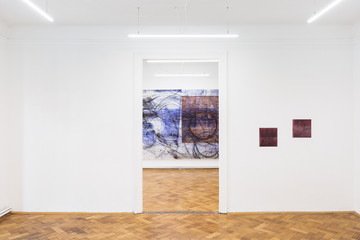
Installation view, Maria VMier, Loggia, Vienna, 2026
![Maria VMier, Conditions and Variables Tisch Tisch Bedingungen des Arbeitens Im Gehen [cut] (detail), 2024-26, Ink, pigment, acrylic, micaceous iron oxide, and vinyl on paper, 230 × 925 cm - © Paris Internationale](https://parisinternationale.com/media/pages/artfairs/2026-milan/exhibitors/deborah-schamoni/9a97af3140-1776289175/2026-01-19-loggia-loggia-000380-full-360x.jpg)
Maria VMier, Conditions and Variables Tisch Tisch Bedingungen des Arbeitens Im Gehen [cut] (detail), 2024-26, Ink, pigment, acrylic, micaceous iron oxide, and vinyl on paper, 230 × 925 cm
Winter 2024, E Williamsburg. As I walk, I fall and catch myself, in a rhythmic sequence. A steady movement into the unknown in manageable sequences. Painting while walking, I thought. I walk and drag a broom, soaked in ink, alongside me. I sow iridescent drops onto the sheets of paper. Painting like tilling a field, I thought. Already, I’ve reached the end of the room. I fold the paper to open the still-covered sections. A format far too wide for my studio floor. An exercise in the absence of an overview, drawn from memory. I retrace the paths again and in many layers. It’s almost spring. I have to leave the apartment and the studio, and return to Munich. The painting lies lightly folded into a package measuring about 60 × 35 × 8 cm in the small storage unit in Two Bridges, Manhattan.
Then in the summer, for my final crit at Bard College, I open it in front of the roughly one hundred students and faculty members present. It tells of the temporalities and the material conditions of its creation. The Fold. I don’t have to say anything. It reveals its principle.
It lies there for a while, still unfinished, half-open, in Munich, in my studio on Gabelsberger Strasse. A few confused strokes. My back hurts. I fold it back up. Then in the fall, it travels with me in an IKEA bag to Cologne, I am Artist in Residence. The studio apartment in the Südstadt has a very large, very shaky wooden table in the middle. It could seat 25 people. I drape the painting over the tabletop like a tablecloth and make a frottage with red pigment.
I paint circles around a few blue plates from the kitchen cabinet. Then on to Munich and on to Vienna. It’s winter again. Organic ink loops become solid rings of iron mica. They are places of rest. From here, I can reorient myself in all directions, they become hubs. The herringbone parquet shows through in some places.
I finish the painting and cut it into two parts for the exhibition. It is installed in two adjacent rooms, separated by a thick wall. Standing in the doorway, I can see the painting almost in its entirety for the very first time.
– Maria VMier
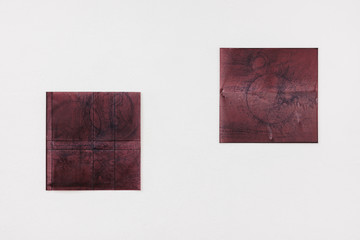
Installation view, Maria VMier, Loggia, Vienna, 2026
Reinforced airdry clay, armature, crisp bags, cotton wool
43 x 49 x 61 cm
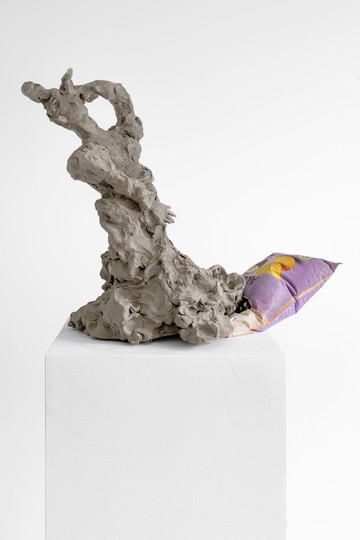
Reinforced airdry clay, armature, crisp bag, cotton wool
45 x 38 x 50 cm
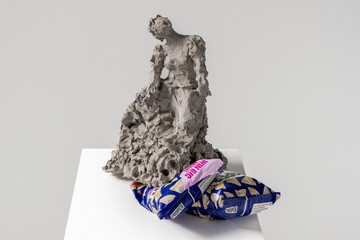
Fainter on posh crisps (Sea Salt, Lentil), 2025
Reinforced airdry clay, crisp bags, cotton wool
42,5 x 46 x 41 cm
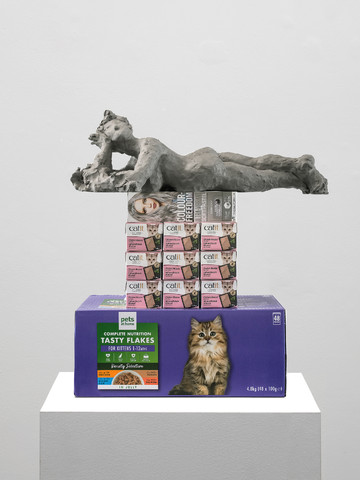
Reinforced air dry clay, cardboard boxes, wood
49 x 43 x 22 cm
![Conditions and Variables Tisch Tisch Bedingungen des Arbeitens Im Gehen [cut] - © Paris Internationale](https://parisinternationale.com/media/pages/artfairs/2026-milan/exhibitors/deborah-schamoni/conditions-and-variables-tisch-tisch-bedingungen-des-arbeitens-im-gehen-cut/987b446f6c-1775569859/mvm057-conditions-and-variables-tisch-tisch-bedingungen-der-arbeitens-im-gehen-cut-upload-360x.jpg)
Ink, pigment, acrylic, micaceous iron oxide, and vinyl on paper
230 x 925 cm
90 ½ x 364 ¼ in
![Fragen [Blei] - © Paris Internationale](https://parisinternationale.com/media/pages/artfairs/2026-milan/exhibitors/deborah-schamoni/fragen-blei/d8cdb28d96-1776290168/mvm059-b-360x.jpg)
Graphite, pigmented calligraphy ink, vinyl, and pigment on paper
41.8 x 59 cm
16 ½ x 23 ¼ in
![Fragen [Blei] - © Paris Internationale](https://parisinternationale.com/media/pages/artfairs/2026-milan/exhibitors/deborah-schamoni/fragen-blei-mvm061/6ff8ab6af8-1775571081/mvm061-360x.jpg)
Graphite, pigmented calligraphy ink, vinyl, and pigment on paper
41.8 x 59 cm
16 ½ x 23 ¼ in
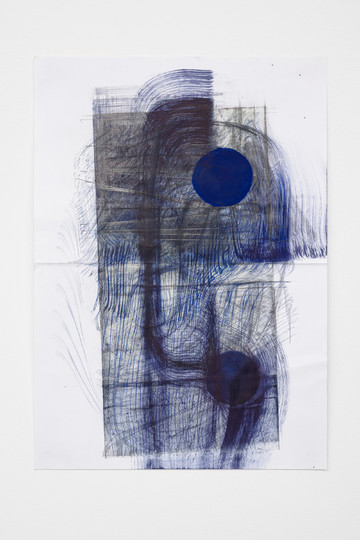
Graphite, ink, and pigment on paper
59 x 41.8 cm
23 ¼ x 16 ½ in
![Orientations [kitchen table] - © Paris Internationale](https://parisinternationale.com/media/pages/artfairs/2026-milan/exhibitors/deborah-schamoni/orientations-kitchen-table/d67892b25f-1775569057/2026-01-19-loggia-loggia-000061-full-360x.jpg)
Fineliner pen, paper, wax, pigment, and spring steel
29.6 x 31.4 cm
11 ¾ x 12 ¼ in
![Orientations [kitchen table] - © Paris Internationale](https://parisinternationale.com/media/pages/artfairs/2026-milan/exhibitors/deborah-schamoni/orientations-kitchen-table-mvm055/f4f5b9943e-1775569324/2026-01-19-loggia-loggia-000045-full-360x.jpg)
Fineliner pen, paper, wax, pigment, and spring steel
31.1 x 29.6 cm
12 ¼ x 11 ¾ in
![Orientations [kitchen table] - © Paris Internationale](https://parisinternationale.com/media/pages/artfairs/2026-milan/exhibitors/deborah-schamoni/orientations-kitchen-table-mvm056/ad68344e18-1775569409/2026-01-19-loggia-loggia-000052-full-360x.jpg)
Fineliner pen, paper, wax, pigment, and spring steel
29.6 x 31.4 cm
11 ¾ x 12 ¼ in
![Selbstverortung in der Maschine [im Kreis in Bewegung, sitzend] - © Paris Internationale](https://parisinternationale.com/media/pages/artfairs/2026-milan/exhibitors/deborah-schamoni/selbstverortung-in-der-maschine-im-kreis-in-bewegung-sitzend/d5a412a1e2-1775568932/mvm027-selbstverortung-in-der-maschine-im-kreis-in-bewegung-sitzend-a-360x.jpg)
Ink, pigment, graphite, and red chalk on kraft paper, folded, with traces along the edges from previous working processes.
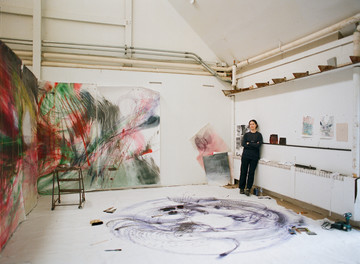
Maria VMier (b. 1985 in Passau, DE) lives and works in New York and Munich. VMier’s large-scale drawings push abstraction to its limits. Her spectral mark-making oscillates between the raw and the delicate, evoking bodies in perpetual motion. Through an insistently physical approach, VMier transforms abstraction into a site for examining embodied knowledge, desire, and socio-political relations from a xecofeminist perspective.
The multidisciplinary practice of Maria VMier encompasses context-specific and collaborative work. Influenced by body politics, their work addresses the centrality of desire – with an eye towards its feminist and political dimensions. VMier’s painting practice is open and process-based. Their forms begin in their Companion series, as they build up intuitive writing gestures into large-format paintings. Their lines – ebullient and dense – create a sense of three-dimensional depth that echoes sculptural forms like the figura serpentinata, a spiral motif prominent in Renaissance art. Their works emerge over time, layering and weaving the strands together. During this process, the format isn’t fixed: VMier folds the paper, cuts it up or extends it.
Following their studies at Bard College and the Munich Academy of Fine Arts, Maria VMier has had prominent presentations at MoMA PS1, Museum Brandhorst, and the Pinakothek der Moderne (all 2024), amongst others. Their practice is grounded in community and collaboration: they regularly invite further artists into their work, they run the artists’ book publisher Hammann von Mier-Verlag with Stefanie Hammann, and are also part of the collective Ruine München.
Works by Maria VMier are held in the public collections of Museum Brandhorst, Munich; the Pinakothek der Moderne, Munich; and Städtische Galerie im Lenbachhaus, Munich.
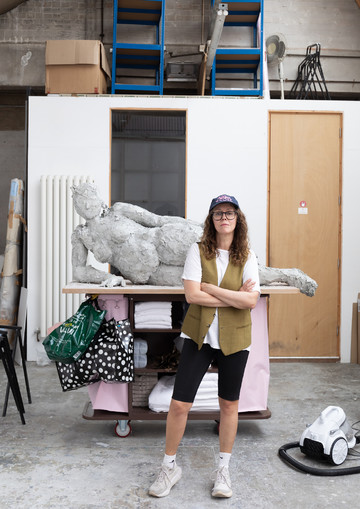
Nicole Wermers (b. 1971, Emsdetten, DE) lives and works in London. For over two decades, Nicole Wermers has explored the physical and structural hierarchies of urban space in relation to the bodies – both present and absent – subjected by them, drawing on references from art history and vernacular culture.
Her characteristically evocative and slyly humorous work often challenge the classical – and male-associated – vertical trajectory of sculpture. Combining and reconfiguring familiar objects into new material forms, Wermers addresses the structures of ritualised social relations and the material objects through which these associations are communicated. These works transform, contain, and frame their environment, prompting a deeper consideration of how surface and design read as social and cultural indicators.
In 2024 Wermers was the recipient of the Helmut-Kraft-Foundation Prize for Fine Arts as well as the Arts Council Acquisition Prize. She has been awarded the Rome Prize of the German Academy Villa Massimo, Rome in 2012. In 2015, Wermers was nominated for the Turner Prize. Since 2017 she has been a professor for sculpture at the Academy of Fine Arts in Munich.
Her work has been the subject of solo exhibitions and commissions at Tate Britain, London, UK; Kunsthaus Glarus, Switzerland; The Common Guild, Glasgow, UK; Lismore Castle Arts, Lismore, Ireland; Aspen Art Museum, Colorado, USA; Kunstverein in Hamburg, Germany; Villa Massimo German Academy, Rome; Kunstverein für die Rheinlande und Westfalen, Düsseldorf, Germany; Camden Arts Centre, London, UK and Secession, Vienna, Austria among others.
Wermers’ works are in the public collections of Tate, London; Museum Ludwig, Cologne; Museum of Modern Art, Frankfurt; Städtische Galerie im Lenbachhaus, Munich; Sammlung Verbund, Vienna; Orange County Museum of Art, Santa Ana, California; Galerie der Gegenwart/ Kunsthalle Hamburg; Sammlung Stiftung Kunsthalle, Kunstmuseum Bern; Bard College, Annandale-on-Hudson, New York; Sammlung zeitgenössischer Kunst der Bundesrepublik Deutschland, Berlin; Government Art Collection, London; British Council Collection, London; Arts Council Collection, London/New York City; Kunstmuseum Ravensburg, Karl-Ernst Osthaus Museum, City of Hagen; DGZ Bank Collection, Düsseldorf; Sammlung Museum Weserburg, Bremen, DE, Museum Brandhorst, Munich and Fondazione Halevim, Milano.