Paris Internationale - © Paris Internationale
Piktogram - © Paris Internationale
Piktogram

Piktogram is a non-profit organization founded in 2005 to publish Piktogram Talking Pictures Magazine and to organize thematic, research-based exhibitions in specially selected venues—such as hotel rooms, the Financial Centre building, or a cinema theater.

From 2011 to 2014, Piktogram ran a non-commercial art space. In 2012, the magazine ceased publication.

In 2011, Piktogram initiated Warsaw Gallery Weekend, in 2015, founded Not Fair, and in 2024, co-founded Constellations.

Since 2015, Piktogram has operated as a gallery and has been representing artists.

That same year, Piktogram relocated from a post-industrial building in Warsaw’s Kamionek district, redesigned by Projekt Praga, to a downtown location. There, it maintained two venues within the same building at 9 Kredytowa Street. In 2022, Piktogram moved again—this time to a ground-floor space with street-facing vitrines at 4 Górskiego Street, right in the center of Warsaw.

Piktogram represents both Polish and international artists, including those of Polish origin living abroad, spanning multiple generations and working across a wide range of media. The gallery also manages artist estates.

We work, play, and experiment with ideas within spatial contexts.

4 Górskiego Street
00-033, Warsaw
Poland

WEBSITE LINK

At the first edition of Paris Internationale Milano, Piktogram is presenting works by Nils Alix-Tabeling and Paweł Olszewski

Piktogram - © Paris Internationale

The works of both artists share a view of reality detached from the common perception of sight. It is as if other dimensions of reality were visible.

Paweł Olszewski, Ascending the Staircase, View Through a Window, 2025, oil on linen, 180 × 160 cm - © Paweł Olszewski and Piktogram, Paris Internationale

Paweł Olszewski, Ascending the Staircase, View Through a Window, 2025, oil on linen, 180 × 160 cm

Piktogram - © Paris Internationale

The reality depicted in Paweł Olszewski’s paintings resembles how it might be perceived by non-human detectors—whether artificial or the sensors of bats or flies. The space in them also brings to mind some undiscovered mutant hybrid of cubism and futurism. The colors are muted, the light is dim, the forms are blurry, abstract up close, the shapes emerge when you step back and look at them from a distance. The atmosphere there is reminiscent of the delirious state of mind of a haunted programmer late at night.

Piktogram - © Paris Internationale

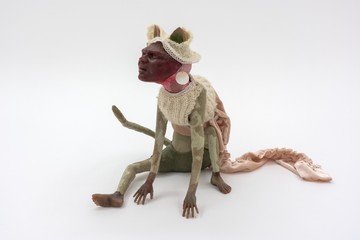
In turn, Nils Alix-Tabeling’s sculptures depicting “cats” look as if they were seen through special “psychological” glasses—they have been portrayed with emphasis on their facial expressions, poses, and gestures, dressed in costumes, personified, with human faces and hands. Through them, we see their character traits, their “human” personality.

You are using an outdated browser.
Please upgrade your browser to improve your experience.