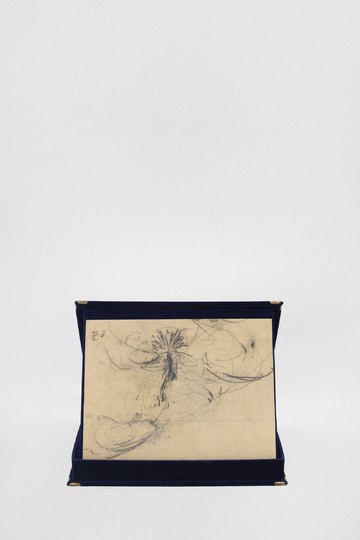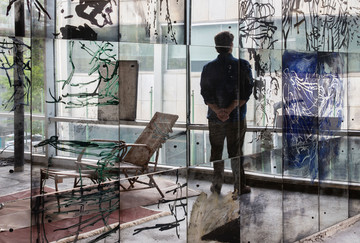
Emanuela Campoli’s presentation at Paris Internationale Milan focuses on the work of Benni Bosetto and Nick Mauss, two artists who take drawing as an expanded practice and work towards a radical reconsideration of the boundaries between applied and fine arts. The presentation features a large-scale, reverse-glass mirror installation by Nick Mauss and a selection of works by Benni Bosetto, echoing her solo exhibition currently on view at Pirelli Hangar Bicocca.
Nick Mauss
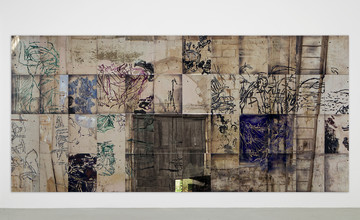
Nick Mauss
Untitled, 2022
48 panels with reverse glass painting, mirrored
292 × 636 cm / 114.96 × 250.39 inches
Reverse glass painting, also known as verre églomisé, was popularized as a folk art technique for depicting religious subjects in 18th and 19th century Europe, and became a catalyst for German Expressionist painting through its introduction by Gabriele Münter to her circle. The lustrous effect of ornament rendered on a silvered ground was also integrated into opulent interior schemes, and reached its pinnacle in the 1930’s through the diverse styles that characterized Art Deco. Mauss’ ongoing interest in the implications of the decorative – either its devaluation as a minor, gendered form, or its utopian dimension, in the exploration of decoration by progressive movements – undermine the division between applied and fine arts. As Mauss stated in an interview « I don’t see another possibility of working, outside of this constant re-orientation towards, and folding in, of multiple histories. In the way I choose to work, I foreground the process of being subjected to influences, and emphasize the shifting of these influences. I see this process of ‘seeing through’ something, or someone, as a way to address this moment. So anachronism is difficult for me. »
Nick Mauss
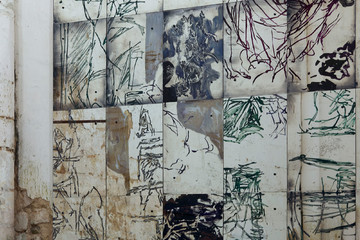
Untitled, 2022 (detail)
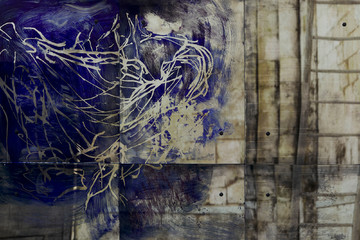
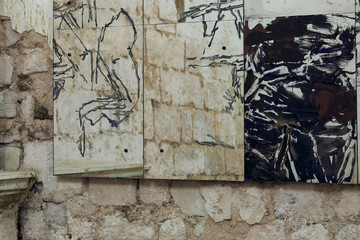
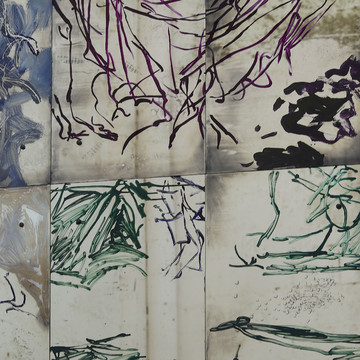
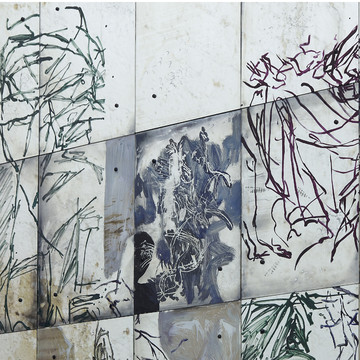
Mauss’ work is the result of an elaborate, delayed process that creates a distance in thinking, making, and perceiving the work, while at the same time maintaining a direct immediacy. Though at first sight the work appears to be painted onto the surface of a mirror, the painting takes place on the reverse side of the glass — under the surface, so to speak. This painted glass is covered in mirror coating, which brings its own unexpected reactions (flares, black-outs, solarizations), so that the finished painting lies within the mirror, not on its surface. Mauss came to this way of working by thinking about suspending drawing in reflected space, humming between direct perception and memory. The glass picture-plane absorbs the viewer, the space in which it exists, as well as other works within the space, and the changing conditions of light. What results is a highly reactive perceptual condition that changes with one’s position in relation to it, suggesting that a picture is not a contained, stable incident, but a system of relationships in which everything is unfixed.
Benni Bosetto
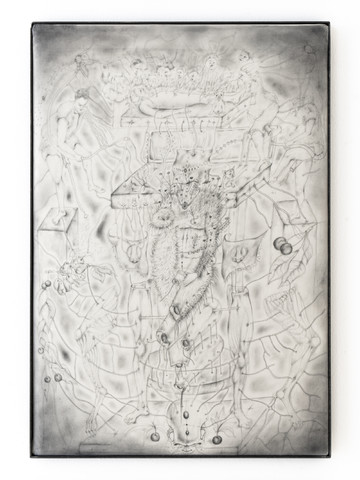
Benni Bosetto
«Like all great mysteries, we are all mysteriously called to love, no matter of our depravity or despair», 2021
80 x 55 x 4 cm / 31.49 x 21.65 x 1.57 inches
Pencil on silk, fabric, wadding, wood, iron
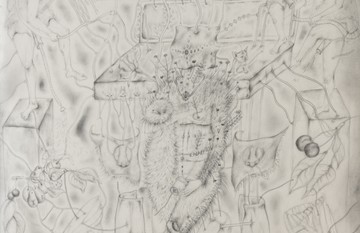
Benni Bosetto
«Like all great mysteries, we are all mysteriously called to love, no matter of our depravity or despair», 2021
Detail
Bosetto’s drawings on silk invite distraction, that state of mind which allows for unexpected connections between alternating moments of concentration and drifting. Populated by hybrid figures—human, animal, vegetal, and microscopic—they form interconnected systems through tubular, biomechanical structures, suggesting a single living organism. Within these compositions, ritual gestures and acts of care emphasize the body as the origin of perception and a repository of memory.
The silk surface, often softly padded, accentuates the works’ oneiric and drifting qualities, reinforcing a sense of suspension and tactile intimacy. In some drawings, a form of automatic writing emerges, where marks seem to unfold freely across the surface.
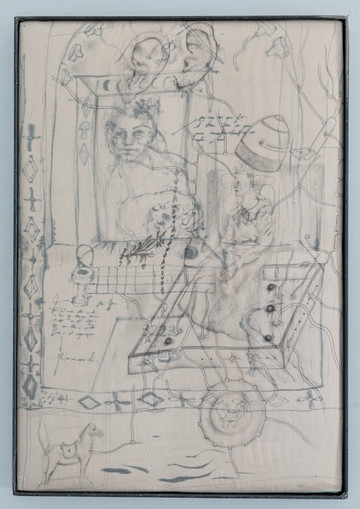
Benni Bosetto
Untitled (You remind me of me), 2022
Pencil on silk, fabric, wadding, wood, iron
43 × 30 × 4 cm / 17 × 11.8 × 1.5 inches
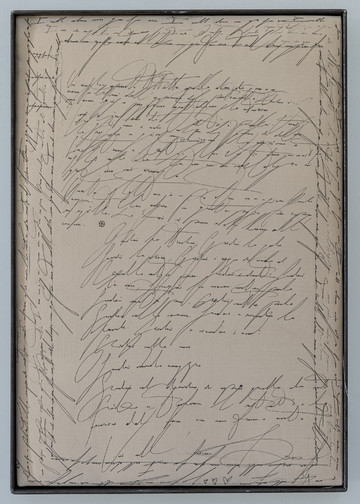
Benni Bosetto
Untitled (Trying to write a poem since I will remember), 2022
Pencil on silk, fabric, wadding, wood, iron
43 × 30 × 4 cm / 17 × 11.8 × 1.5 inches
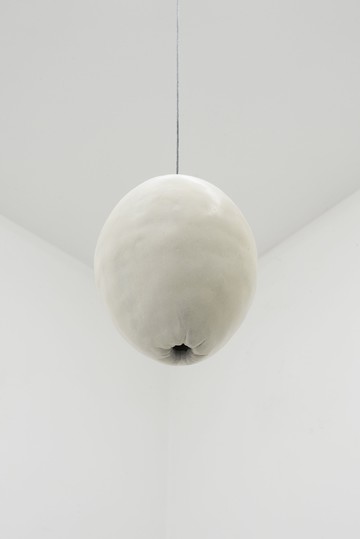
Benni Bosetto
Uovo, 2026
Ceramic
Variable dimensions
The work Uovo (2026) by Benni Bosetto is rooted in a reflection on the potential of pre-logical thought—an embryonic reflective state and, at the same time, a physical condition in which the body manifests itself in its erotic and instinctual nature.
The piece consists of a suspended ostrich egg, inspired in its form and position by the one depicted in the Brera Altarpiece by Piero della Francesca, and is conceived as a possible outcome of these wanderings of thought. A symbol of the Immaculate Conception, the egg is ironically subverted, transforming it into an image charged with physicality and erotic tension.
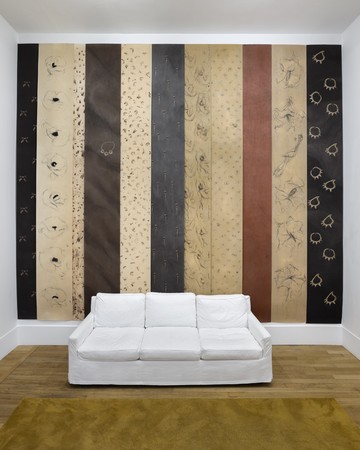
Benni Bosetto
Cellule, 2025
Handmade wallpaper drawing installation
Variable dimensions
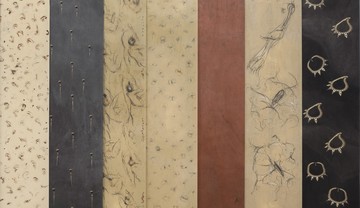
Benni Bosetto
Cellule, 2025
Detail
The title Cellule evokes the cell, the smallest unit of organic tissues—a concept that the artist expands into space by transforming surfaces into a kind of skin, a membrane that both defines a boundary and serves as a place of contact. Vertical strips of paper, hand-painted by the artist, overlap to create the atmosphere of a domestic interior rich in details and ornamentation. The space appears familiar and intimate: an environment ready to welcome.
Numerous drawings and collages appear on the papers, including bodily imprints, erotic and vegetal motifs. Bosetto describes drawing as a time of total presence, in which body and perception intertwine: “A radicality that lives in the everyday gesture. An erotic and at the same time spiritual fusion.” The jewels, which constitute the main subject of her collages, are instead images cut out and collected over time, part of the artist’s research on ornament and decorative objects as tools for transforming space.
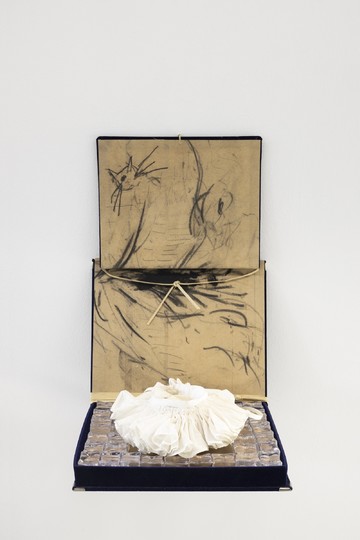
Benni Bosetto
Il collo del gatto dí Edgar A.P, 2026
Mixed media
25 x 30 x 5 cm / 9.43 x 11.81 x 1.96 inches
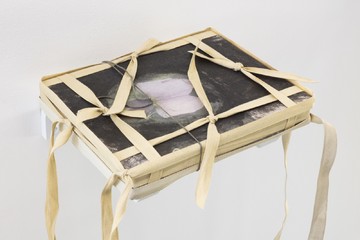
Benni Bosetto
Casa occupata, 2026
Mixed media
25 x 30 x 5 cm / 9.43 x 11.81 x 1.96 inches
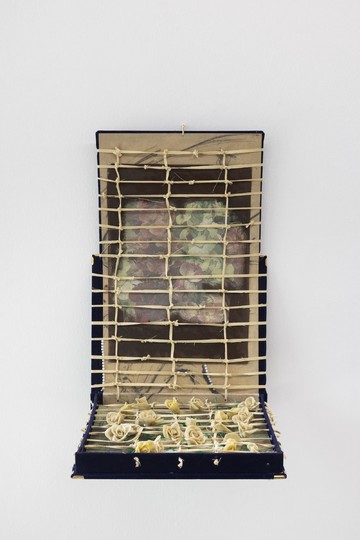
Benni Bosetto
Non è poi cosi la fine del mondo, 2026
Mixed media
25 x 30 x 5 cm / 9.43 x 11.81 x 1.96 inches
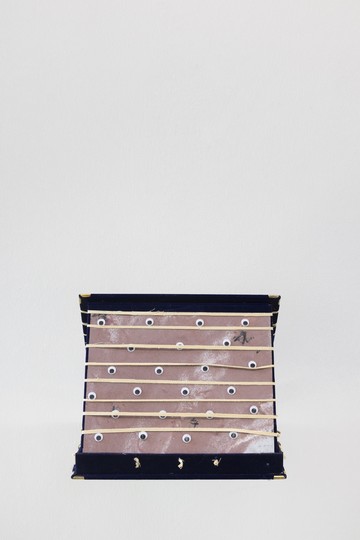
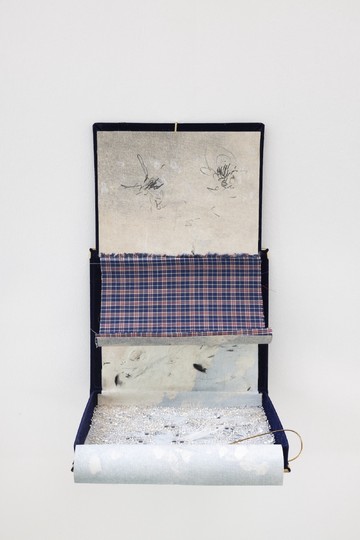
Benni Bosetto
Il cielo di Delacroix, 2026
Mixed media
25 x 30 x 5 cm / 9.43 x 11.81 x 1.96 inches
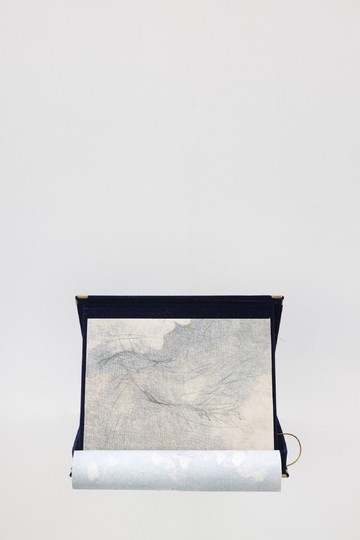
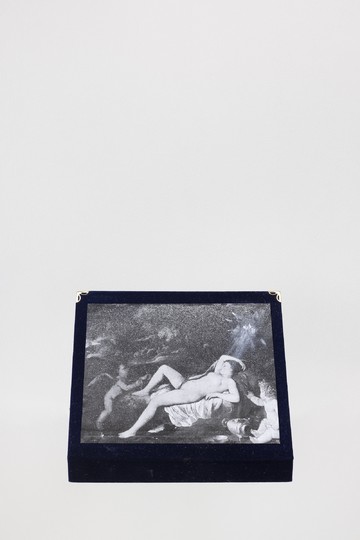
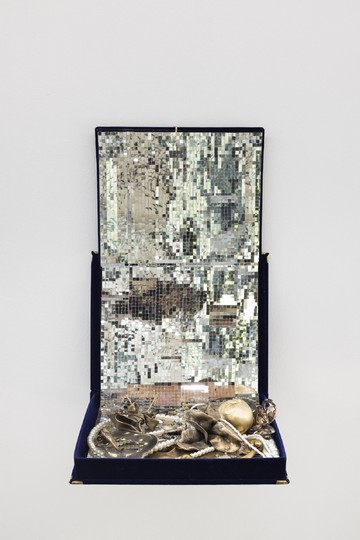
Benni Bosetto
Numero 5, 2026
Mixed media
25 x 30 x 5 cm / 9.43 x 11.81 x 1.96 inches