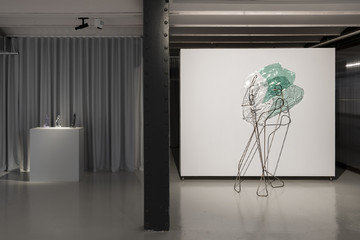
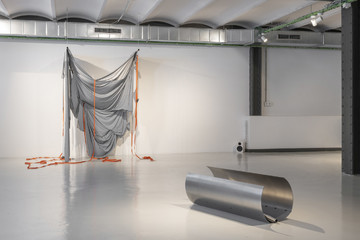
For their shared stand at Paris Internationale 2026, Vicky Uslé and Natalia Domínguez converge around a common, albeit unstable, territory: the threshold between materiality and dissolution. Bringing together Hefesto and Lack Of, the presentation unfolds as an environment in which air, fire and vapour operate not as fixed elements, but as agents of transformation mediating between the body, space and perception.
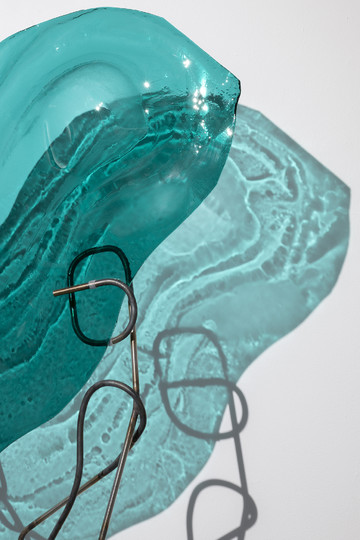
Domínguez’s practice places us within a dense, almost unbreathable atmosphere, where industrial residues and organic forms blur into hybrid organisms. Her work insists on making visible that which eludes capture: air as a relation, as a tension, as a condition of shared existence. In parallel, Uslé approaches matter at the moment before it stabilises, using glass as a fluid, luminous medium shaped by fire, where intuition and memory converge in a sensory process of becoming.
The stand is conceived as a suspended field, oscillating between condensation and transparency, between suffocation and release. While Domínguez constructs an ecology of entanglement rooted in the urban and the corporeal, Uslé opens up a space for introspection in which light fractures and expands perception. Together, their works articulate a choreography of unstable states, where what is seen and what is felt are in constant flux, proposing a shared exploration of the fragile boundaries between interior and exterior, control and surrender, form and its continual disintegration.
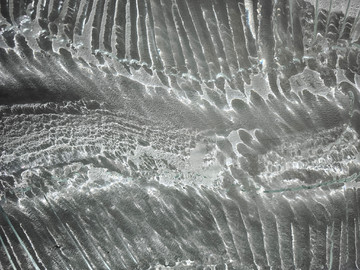
HEFESTO, Vicky Uslé
Hefesto is the new exhibition proposal by Vicky Uslé (Santander, 1981) for House of Chappaz. I say proposal rather than work because this is how the artist herself describes it when I ask her about the project: she does not work, she moves through a self-reflective process via her artistic practice which, driven by desire, is currently in a moment of change and transformation.
Vicky Uslé departs from her usual register and language—painting on paper and canvas and photography—to experiment with glass as a plastic and expressive material. Although she perceives it as something ancestral, something she carried within in a whispering way, the use of this material is relatively new for the artist. Together with master artisan Sara Sorribes, she unconsciously propels the process toward a much more sensorial realm. Hefesto emerges from this impulse to release intuition and surrender to the process. As if she were a small child, she activates a mode of creation guided by instinct and play, seeking to reach a certain sense of calm.
Although photography has always been present in her practice, it now takes on a more central role, generating a pictorial, highly plastic investigation in relation to experimentation with glass. In Hefesto, glass enters into dialogue with photography within a single body of work, producing a set of pieces that complement those recently shown at Sala Robayera: the previously unseen works in this exhibition and those shown last year in Cantabria are part of the same process, part of the same relationship with fire.
For Uslé, her previous materials felt obsolete, while glass provides a series of qualities already present in her earlier pictorial work and connected to her personal and family memories, such as light and reflection. Uslé grew up in a water mill that has deeply shaped her imaginary and visual language; the irregular, handmade windows generated flashes through the movement of water and the unpredictable impact of light, creating spaces in which to lose oneself in the colors of glass kissed by the sun, reflected on the walls and transformed with the shifting sunlight. Everything begins with this encounter between light and its limit, within this threshold.
Through the plasticity of glass, the artist seeks to return to that instant—an instant in which what wants to be has not yet decided how. Fire and water resemble one another as mediating forces in processes of creation and, at the same time, destruction; both are energetic images. As she explains: “I feel that there is a reflection of my interior in each piece. Of that liquid that inhabits me. What flows within me. Plasma, blood, bile… Like water.” These works represent a return to the self and to inhabiting the body; they do not describe, but reveal their own will to be.
Elena Blesa Cábez
Head of Education and Mediation at Manifesta, independent curator and researcher
LACK OF, Natalia Domínguez
Natalia Domínguez has been trying to answer this question for some years: how to capture a cloud? Hence her fixation on the air, where to remain in suspension, where, perhaps, to fall. She approaches air as an element that is difficult to define, both formally and conceptually. Although he is aware of the impossibility of this gesture, he insists. And this fixation is not childish, it is a question about the instant, about language and about the changing nature of our context. Whether from a formal approach or from a symbolic search, he seeks to make the apparently imperceptible present, by means of echo or reverberation.
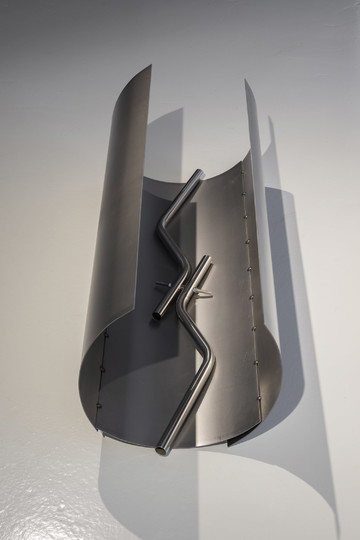
On this occasion, rather than a cloud, we could speak of vapour, of smoke, of a heavy, humid, sticky air, typical of a contemporary imaginary that is less and less science fiction. At the bottom of the space, on the ground, we find a formless, vibrant, iridescent animal whose nature is difficult to grasp, almost like a crawling cyborg. The urban environment is the habitat of this organism, just as it is the habitat of the ventilation pipes we see everywhere, which also breathe, condense steam, inhale and exhale, surrounded by totally industrial elements. If the steam stands out for its deformity and adaptability, the tube contrasts with its rotund presence, sculptural in its most classical sense.
A deep, rhythmic exhalation, which gradually accelerates, at times nervous, choppy, an anguished shortness of breath that becomes more and more present… With this contemporary sensation of lack of air, which is subtly hinted at in the title of the exhibition, we enter the habitat of these creatures. The lack of evidence of the interdependent relationships that condition the existence of almost any organism. Air, in this case, could be understood as an environment of interrelation, of connection between inside and outside, between the different singularities that cohabit a given place, in this case, the exhibition space.
The latter is dominated by a large sculpture that unfolds its indeterminate form in the middle of the fall and acts as a bridge to the ST (parachute) series on which she has been working since 2022. The artist thus traces a link with her previous production, where air continues to be a central element, although the material vocabulary she deploys here, the formal and conceptual approach, is much more abstract and subtle than in previous proposals. The use of materials with organic animal reminiscences, at the same time traversed by the notion of the technical or of security, such as the quilts, or the raw iron finishes, reveal a bodily approach throughout the proposal.
The bodily, personal experience of the urban environment leads the artist to ask herself collective questions, questions that interrogate a context in which the processes of transformation from raw material to processed material accelerate contemporary models of production, distribution and accumulation. Where those prefabricated, industrial, mass-distributed elements draw the capitalist landscape.
Elena Blesa Cábez
Head of Education and Mediation at Manifesta, independent curator and researcher
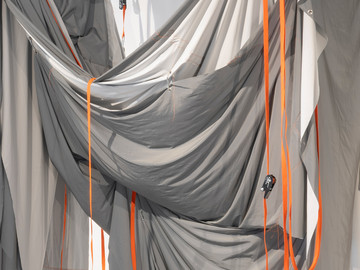
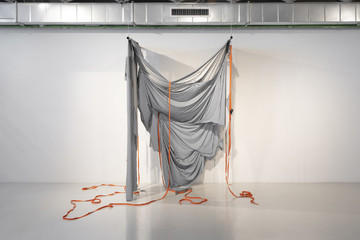
Reflective fabric, thread, carabiners, rope, ratchets and stainless steel tubes
190 cm x 220 cm x 175 cm approx. (variable measurements)
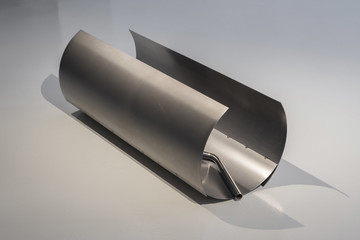
Laminated plate curved in cold, folded stainless steel tubes and threaded stainless steel rod
105cm x 36.5cm x 39cm
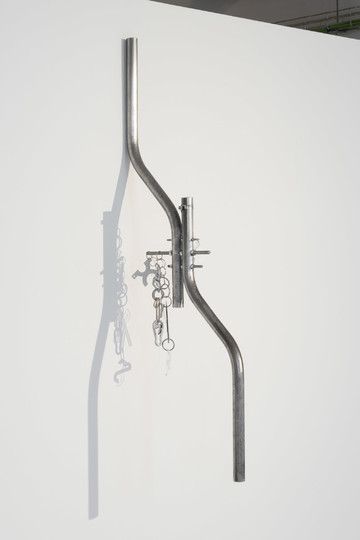
Folded iron tubes, threaded stainless steel rods, washers, couplings and methacrylate figures
98cm x 33cm x 6cm
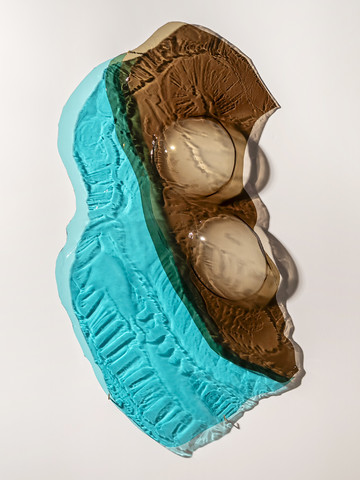
Artisanal glass mass
138 x 80 cm
Unique piece
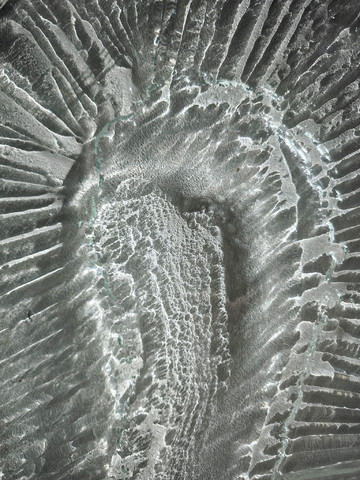
Framed photograph
112 x 151 cm
Ed. 1/3 + AP
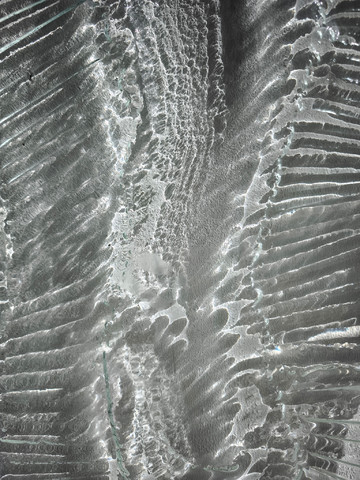
Framed photograph
112 x 151 cm
Ed. 1/3 + AP