Based in Seoul, where he lives and works, creates paintings that investigate the essence of
humanity and the narratives gradually disappearing in contemporary society. Through
repetitive structures and fragmented imagery, he reconstructs desires inherent to the human
condition, translating them into a distinct painterly language. His works flatten notions of
locality and temporality by incorporating architectural elements and collage techniques to
establish a visual order. By assembling repetitive and symbolic images, Yi constructs new
narratives while seeking a painterly structure that transcends mere juxtaposition and
suggests a sense of necessity, continuously expanding the potential of painting.
Yi earned his B.F.A. from Dankook University, received his M.F.A. from Hongik University
Graduate School, and completed his doctoral coursework in painting at Hongik University
Graduate School in Seoul. His work has been widely exhibited in solo and group
presentations, including solo exhibitions such as Tolerances at WWNN, Seoul (2026);
Metamorphosis of Frames at OCI Museum of Art, Seoul (2024); and A Drone Crashed into the
Ground When the Remote Control Failed at Art Center Epoch, Seoul (2023). His selected
group exhibitions include presentations at AOD Museum, Seoul; CON_, Tokyo; Horton Gallery,
Seoul; The Hole, New York; Everyday mooonday, Seoul; and Yangpyeong Art Museum, among
others. He was selected as an OCI YOUNG CREATIVES artist (2023–2024) and an Artist
Prologue selection at Art Center Epoch (2023).
Instagram @yiyounguk
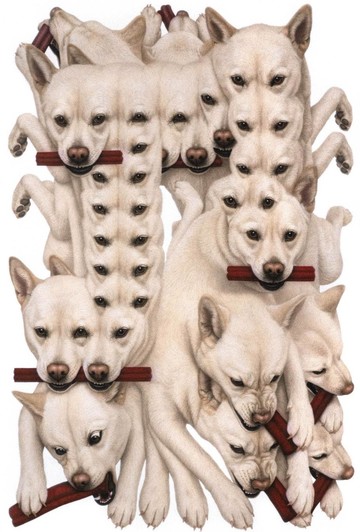
Younguk Yi (b.1991)
A Portrait of a Dog slowly revealing the fact that humans who believe they know best what their dog
loves end up repeatedly calling the dog’s name in front of the reality that its gaze and direction always shift according to the fingertips holding a treat and that they were in truth loving the moment that happiness returns toward them more than the happines s itself
2026
Acrylic on linen
194 x 130 cm
16,000,000 KRW
12,000 USD
10,000 EUR
Artwork Descriptions
People buy treats that their dogs love and watch them devour them eagerly, thinking to themselves that they are quite good owners. The happier the dog appears, the more fulfilled the owner feels, sometimes even offering an extra treat just to experience that satisfaction.
While the dog is simply excited for the food, humans use these fleeting moments to affirm their own love, dedication, and even moral goodness. This work questions how easily the comforting belief of making someone else happy can turn into self-gratification, and in the process, asks precisely who is eating for whom.
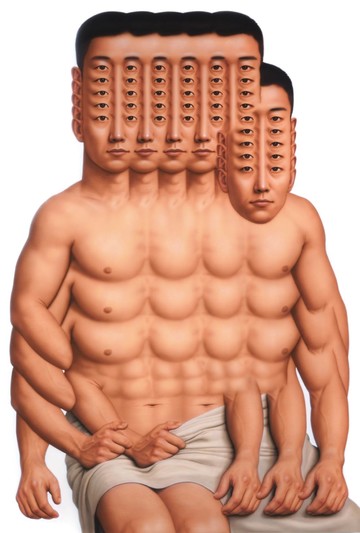
Younguk Yi (b.1991)
A portrait of one who stares ahead with composure yet shifts restlessly, trapped in quiet anxiety
2025
Acrylic on linen
194 x 130 cm
16,000,000 KRW
12,000 USD
10,000 EUR
Artwork Descriptions
On the surface, things may appear orderly, yet the most precarious structures are often those of internal order. Using the architectural elevation of the 1995, Sampoong department store collapse in Seoul, a major structural disaster that shook South Korea as its structural foundation, this work constructs a space where a figure’s anxiety and obsession iteratively multiply. Despite a calm facial expression, the body continuously trembles and fractures, turning the desperate will to hold together into something bizarre. The collapse of a physical building thus operates anew as the psychological structure of an individual.
Based in Seoul, where he lives and works, Hyunwoo Lee explores sculpture by emphasizing its
enduring weight and permanence, distinguishing his practice from contemporary tendencies
toward lightness and expansion through cross-media hybridization with photography,
painting, 3D printing, and data. Lee’s sculptures anchor the coordinates of an imagined era by
embracing a sense of anti-real-time. He describes this as a peculiar, monumental quality of
sculpture, viewing the sublime repetition of endlessly chipping away blocks in search of form
as an integral part of sculptural practice. Although his works may initially appear absorbed in
visual stimuli, his continuous artistic experimentation ultimately aims to deeply comprehend
contemporary tragedies, condense them, and bring them into visible form.
Lee earned his B.F.A. in Sculpture from Chung-Ang University in Seoul. His work has been
widely presented in solo and group exhibitions, including solo presentations such as Goldberg
at WWNN, Seoul (2025); Acardius at Diesel Art Gallery, Tokyo (2024); Parenthesis at G Gallery,
Seoul (2023); and oWo at Alterside, Seoul (2021). His selected group exhibitions include
presentations at Page Gallery, Seoul; Sai x Con, Tokyo; WWNN, Seoul; Afterhours, Paris;
Shower, Seoul; Con Gallery, Tokyo; IIR, Seoul; 021 Gallery, Daegu; Gaasp, New York; Of, Seoul;
413-Pack (Online); Outsite, Seoul; Uartspace, Seoul; and Lad, Seoul, among others.
Instagram @pip_archive
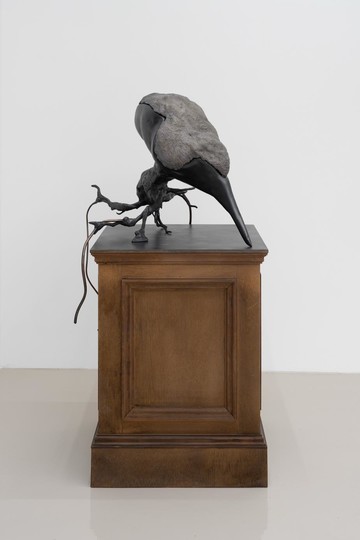
Hyunwoo Lee(b.1994)
心- 無我(Sim-Mua)
2026
Snake shed, cement, plaster, epoxy putty, epoxy resin
UV resin, urethane clear coat, driftwood branch, copper
and graphite
65 x 60 x 55 cm
8,000,000 KRW
6,000 USD
5,500 EUR
Artwork Descriptions
The work
Based in Seoul, where he lives and works, Jonghyun Park (b. 1996) focuses his artistic practice
on visual traces that capture personal memory alongside collective wounds and traumas. His
work explores how these traces interact with the layered layers of painting as a medium,
engaging what he defines as a “symptomatic” approach rich in metaphor and representation.
Investigating the narrative potential of images and the interstitial space between a surface
and its conceptual weight, Park addresses core questions of pictorial representation and
painting traditions. Through exhibitions that critically reflect on the history of painting’s
repression and return, he situates his practice within this critical discourse while addressing
the challenges facing contemporary painting.
Park earned his B.F.A. from the Department of Painting at Seoul National University. His work
has been featured in solo and group presentations, including solo exhibitions such as PARADE
at WWNN, Seoul (2025); and Couch at Boan Yeogwan, Seoul (2024). His selected group
exhibitions include presentations at Woosuk Gallery, Seoul; YK Presents, Seoul; and Gallery in
HQ, Seoul.
Instagram @pb___1
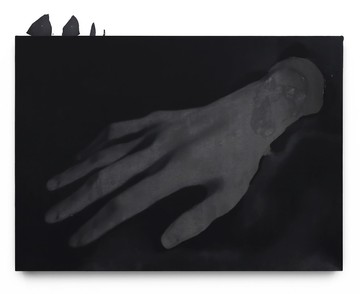
Jonghyun Park (b.1996)
Chopin’s D#, E♭, A♭, D# hand
2024
oil beneath veiled canvas
80 x 100 cm
4,000,000 KRW
3,000 USD
2,500 EUR
Artwork Descriptions
This piece encounters the image of a white plaster cast of Chopin’s hand: long, pale, large, slender, severed, white, and right. It is a duplicated replica of a hand that once played instruments and caressed the piano keys, one of several casts, and notably the palest among them.
Perceiving this hand as simultaneously ghostly and arresting, the artist sought to render that eerie intensity into paint. The hand was painted in oil, and before the oils could dry, the canvas was veiled in black fabric. Emerging from behind this veil, the form drifts faintly across the surface. Like a specter, the image of the painting vanishes when viewed from an oblique angle.
“When the hand spreads so wide as to cover a third of the keyboard, it looks like a giant viper about to swallow a rabbit whole.”
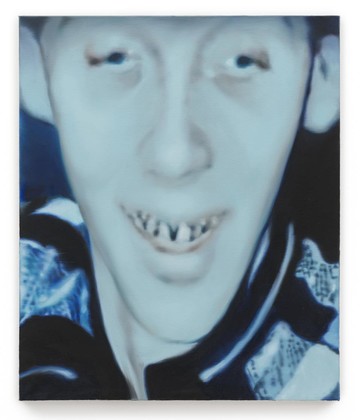
Jonghyun Park (b.1996)
American
2025
oil on canvas
45 x 38 cm
2,000,000 KRW
1,500 USD
1,250 EUR
Artwork Descriptions
This work translates a scene from Harmony Korine’s film Julien Donkey-Boy into painting. A character’s face, filling the canvas, emerges amidst blue tones and blurred contours. While the exposed teeth recall a vampire, the expression is less threatening than somewhat clumsy and absurd. This face, where the grotesque and the comical coexist, resists being fixed into a single character or fixed meaning.
Rather than following the narrative arc of the film, the artist transposes the unstable impression of the image itself onto canvas. The title American introduces a context distinct from the film. The name evokes the possibility of connecting the image to separate historical and cultural layers, aligning with an interest in how the legacies of Japanese colonial rule and Western cultural imagery overlap within Korea’s modern visual culture. The facade of the former Mitsukoshi Department Store, explored in last year’s Park’s solo exhibition PARADE at WWNN, is one such case.
Today, an image of a cowboy hat floats on a screen mounted on the exterior wall of the building, now the Shinsegae Department Store, while a fountain sculpture built during the military dictatorship stands before it. Architecture from the colonial era, signs of American pop culture, and monuments from Korea’s modernization era belong to different epochs yet coexist within a single landscape. In American, the title similarly endows the image with a new layer. Placed under the designation of “America,” the face in the film transcends simple portraiture to become a site where Western imagination, cultural assimilation, and colonial experience intersect.
Here, America operates as a signifier where disparate contexts overlap, leaving a gap between the grotesque, comical expression of the face and its title, and revealing the moment an image breaks free from its original context to acquire new meaning.
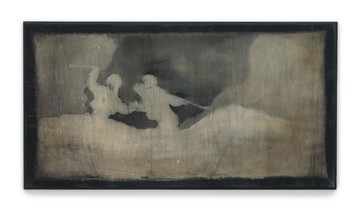
Jonghyun Park (b.1996)
A Duel
2025
oil on linen mounted on wood panel,
epoxy resin
50 x 93 cm
3,500,000 KRW
2,500 USD
2,200 EUR
Artwork Descriptions
A Duel is a work that references Francisco Goya’s Fight with Cudgels. Taking a photograph of Goya’s interior wall paintings, captured by the French photographer Jean Laurent, as its starting point, the artist inverted the contrast of the original image, presumed to be a glass plate negative, and transferred it onto canvas. Liquid resin was then poured over the surface to encase the painting within layers, and the cured surface was physically damaged through sanding and engraving. Rather than faithfully preserving the image or restoring it to its original state, this process exposes the transformations and losses the image undergoes as it passes through various mediums. In this work, the resin functions simultaneously as a transparent membrane protecting and preserving the painting and as a material limit restricting the image’s visibility. Instead of appearing directly on the surface, the forms beneath the resin layer are mediated and refracted by the material. Combined with the subsequent acts of sanding and engraving, which deliberately mar the surface, the image is placed in a space between the opposing forces of preservation and damage. Goya’s painting is first duplicated through the recording medium of photography and then resettled within a material surface via negative conversion and pictorial representation. A Duel continuously delays access to its depicted forms even while recreating them in paint. The image remains, but reading it clearly is hindered by the physical interventions on the surface. Here, painting ceases to be merely a tool for restoring past images; instead, it becomes a device that reveals the very process by which an image is simultaneously preserved, transformed, and obscured.
WWNN