Shadi Harouni (b. 1985, Hamedan, Iran) is an artist based in New York and Tehran.
Her practice includes video installations, architectural interventions, sculptures, photographs, prints, and archives. Her work, set often in cemeteries and quarries throughout Kurdistan, are close studies of a history of dissent and resistance in the region.
The themes Shadi Harouni addresses are rooted in the history of her native Iran; she often engages in a play with language to connect this history to a universal experience of loss, repression, recovery and defiance. Her work centers on the politics of space and of the gaze, and the tension between the moment of revealing and that of concealment. Her work often evokes a relationship between fullness and cavities, taut with the tension of hiding and the desire to reveal.
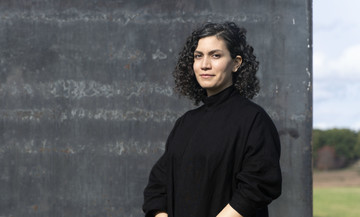
Shadi Harouni’s portrait
Sunken Garden: Beheshte Zahra Cemetary, Section 33, chromogenic prints, cm 40,5 x 30,5, ed. 3
Is a series of 25 chromogenic prints conceived in 2018 and printed in 2026.
The photographs were taken clandestinely of the graves of dissidents who were executed and buried by the then-regime, but mysteriously paved over weeks after the Iranian Revolution in 1979. Over the past forty years, the stones have been forcing their way out of the pavement and they continue to rise. Relatives and friends of the victims continue to bring flowers despite part of the architecture of the tombs being hidden by concrete, demonstrating that memory cannot be erased in any way.
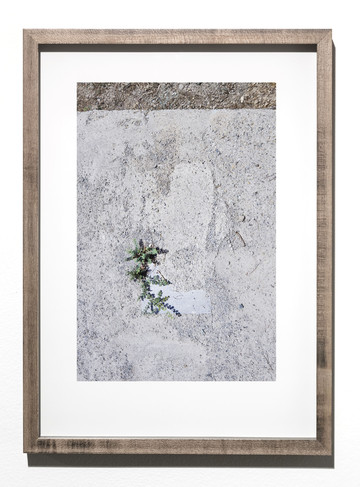
Shadi Harouni, Sunken Garden: Beheshte Zahra Cemetary, Section 33 #4, 2018
Stéphanie Saadé (b. 1983 in Lebanon) is an artist who lives and works between Beirut and Paris.
Her practice includes installation, sculpture, drawing, and collage – eloquently delineate a wide-ranging artistic exploration. Her works orchestrates an evocative lexicon rooted in poetic nuance and metaphorical resonance. A profound sense of enigma frequently derives from the artist’s intimate life, yet her personal history is invoked solely as a conduit for universal truths.
She affects objects and photographs in a subtle way, measuring terms of growth or decrease, articulated by time, weathering and other natural phenomena. Through a language of suggestion she shares clues, signs, imageless and occasionally silent trails with us, which interact like the words of a single sentence. It is for the viewer to decipher them, as would an archaeologist faced with traces, fossils, and fragments. Playing with poetics and metaphors based on stories, history and personal experiences, Stéphanie Saadé finds a delicate balance between what is fleeting and what is tangible.
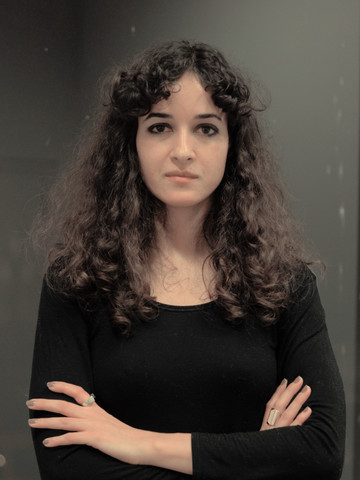
Stéphanie Saadé’s portrait
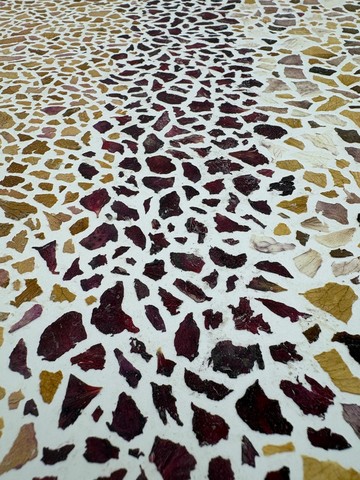
Flower Terrazzo, 2026, petals of different flowers, glue, cardboard, 84 x 118 x 4 cm (with frame) 74 x 108 cm (without frame)
The practice of collecting and assembling recurs often in her work and Flower Terrazzo (2026) is a sample. It is a collage that at first appears to be a portion of a terrazzo floor –
a Venetian flooring technique highly emblematic of Lebanese homes. However, the texture here is not marble, but petals from flowers received and bought by the artist and her daughter. After withering, the flowers are gathered, dried, crushed into smaller bits, and meticulously assembled on paper. Each of these works results from a slow process in which the artist collects material at home, her attention gradually shifting toward these everyday elements within the space where she lives and works.
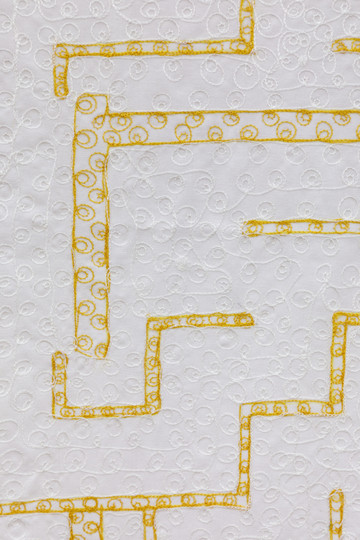
We’ve Been Swallowed by Our Houses, 2020, Aghabani embroidery on cotton cloth, cm 240 x 140, variation 3/3
We’ve Been Swallowed by Our Houses is an embroidered tablecloth featuring a large Aghabani motif (a traditional Syrian embroidery technique, commonly found in Lebanese homes). It traces the floor plan of her former home in Beirut, which also housed her studio. During lockdown, the artist measured her apartment in Lebanon and drew a map of it, which she then turned into a navigable labyrinth.
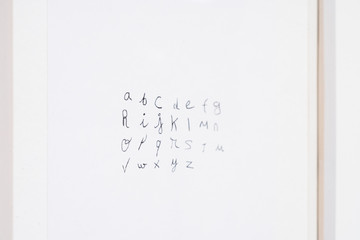
Alphabet, 2022, ink on paper, 14,8 x 21 cm (without frame) / cm 28,5 x 22 (with frame)
An alphabet is composed of letters written each by a different person, encountered during a walk. This was made on the 9th of June 2022, between 16:27 and 16:58 at Jardin des Tuileries, Paris, FR.
The names of the people who were involved in this Alphabet are
a: Thomas, b: Bastien, c: Stéphanie, d: Aurore, e: Kevin, f: Fabien, g: Pauline, h: Lucas, i: Léna, j: Armand, k: Aya, l: Timothy, m: Inès, n: Pauline, o: Mathilde, p: Papa, q: Lisa, r: Ana, s: Diego, t: Yness, u: Sophie, v: Julia, w: Cindy, x: Stéphanie, y: Pepa, z: Lou.
[…]