JIUN KOO
Jiun Koo (Korean, b.1990) brings together mythic imagination and contemporary imagery to conjure hybrid worlds inhabited by heterogeneous beings. Moving across species, gender, and the boundaries of the human, Koo unsettles the classificatory systems our society has long taken as “normal.” By stitching together scenes where animal and human, ritual iconography and contemporary visual languages interlock, Koo builds an unfamiliar yet vividly animated realm of new life-forms. Unfolding across the pictorial field, these imagined presences refuse confinement within a single category, loosening binary frameworks and revealing the diversity of life and alternative ways of perceiving beyond what is familiar. Through this hybrid cosmology, Koo explores new possibilities for coexistence.
Koo graduated with a BFA and MFA Painting from Ewha Womans University. The selected solo exhibitions include Ashes Becoming (INGAHEE, 2026), Pishacha, Preta, and Yaksha (Space illi, 2024), and Tal-Mythology (Pluripotent Art Space & Space Mirage, 2023). Selected group exhibitions include Dream of Fox (The Small Museum of AOLDA, 2026), Something in the Air (YPC Space, 2025), and 2024 New Rising Artist: Byproduct (Jeju Museum of Contemporary Art, 2024). Koo was selected for Jeonbuk Youth 2027 (Jeonbuk Museum of Art), and Young Artist’s Lab (Arts Council Korea, 2023).
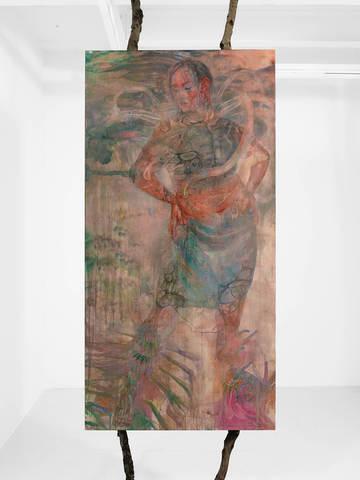
I. Androgynous God of Terramaris
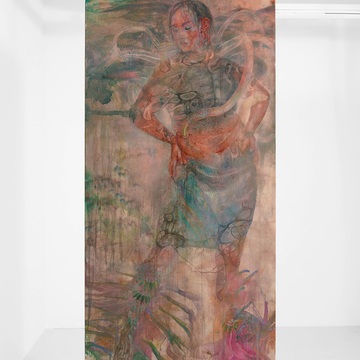
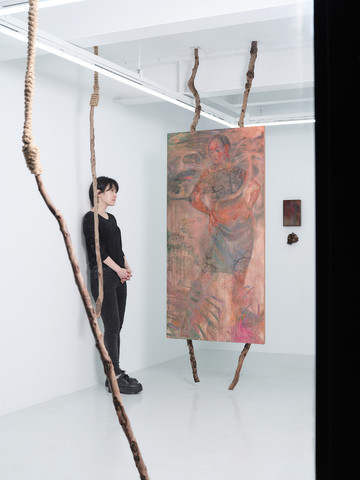
A figure stands within a tall, vertical canvas. Hands on hips, the stance is firm and centered, yet the upper body is encased in a crustacean’s shell, leaving the figure’s sex impossible to determine. This genderless silhouette, in which the human and the non-human intermingle, continues the lineage of androgynous gods that Koo Jieon has developed across earlier series. Unlike those works, however, the figure does not assert itself through a crisp outline. It seeps into the dark, oxidized tones of the background and a reddish earth color, until it is unclear where the body ends and the ground begins. The lower the eye travels, the further the figure dissolves; water and land, generation and extinction coexist within a single canvas, each eroding the boundaries of the other.²
What the work reveals is more than a shift in painterly style. The way the figure loses its boundary with the background is itself the narrative. Koo has spoken of a long-held unease with her own corporeality. If the sense of never fully belonging to either side, in a world where gender functions as a fixed category, shaped the ontological terrain of the Androgynous God series, then in From the Ashes that sensation reaches the canvas for the first time, through the erasure of the body’s very contour.
It is no coincidence that this self-awareness led Koo to myth. In search of a language for imagining her existence beyond the gender binary, she found its closest form in the gods of myth, who were often conceived as beings without sex or as beings of both sexes at once: Ardhanarishvara of Hindu tradition, the composite form of Shiva and Parvati whose body is half male and half female; Hermaphroditus in Greece; Ishtar in Mesopotamia; and the deities of ambiguous sex in ancient Egypt. Over time, human history imposed the frame of gender on these gods, rendering them feminine or masculine.³ Koo’s Androgynous God seeks to return to what came before: a god prior to the assignment of sex, or one in whom sex has already dissolved.
Androgynous God of Terramaris, 2026
Acrylic on canvas, 162 × 81 cm
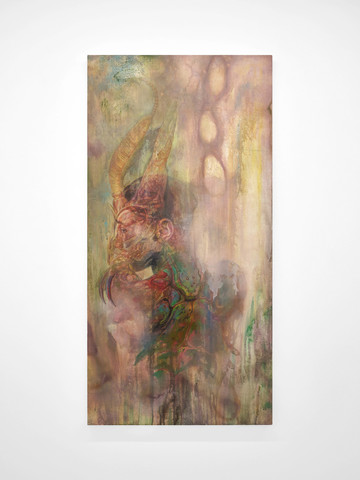
II. Molts
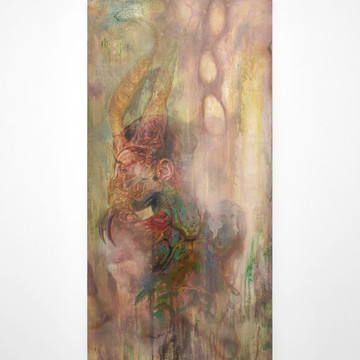
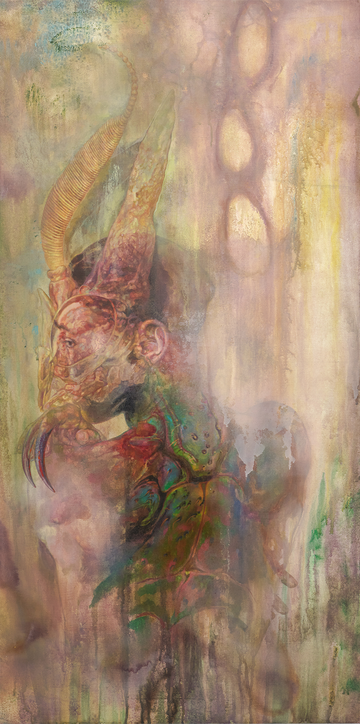
In Molts, fragments of insect bodies rest on a human back. The head of the devil’s flower mantis (Idolomantis diabolica), a tropical insect, and the inner structure of a jewel beetle’s abdomen, with its hard, lustrous shell and the unfamiliar grain of its underside, are layered over human skin. Such hybrid imagery recurs throughout Koo’s practice. Mantises and other insects are chosen for the singularity of their materials: hard chitin, alien segments, thin shells through which the interior shows. Placed upon the surface of a human body, this visual strangeness raises a question about what counts as a “normal” body.
Before turning to painting, Koo worked as a special effects makeup artist, a practice of building a new being on top of another person’s skin. Layers are applied, hardened, and worn away until something other than a human face emerges: a monster, a god, the dead. The makeup artist constructs an interior by way of the surface. In Molts, this experience returns as the logic of the canvas, but in reverse. Where makeup covers, these painted surfaces turn toward peeling away. The shell, or exoskeleton, is at once the trace of molting and the herald of a new possibility. To shed one’s skin is not to abandon a former self, but to leave the form that once contained it.
Molts, 2026
Acrylic on canvas, 116 × 58 cm
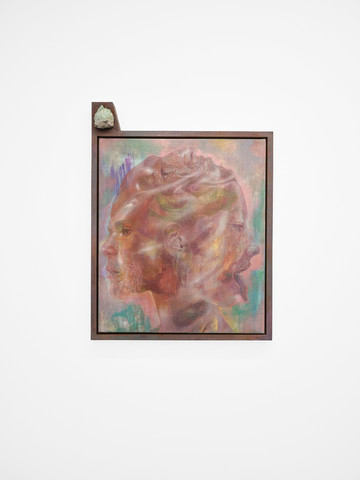
III. Gryllos–Three-faced Aberration–First
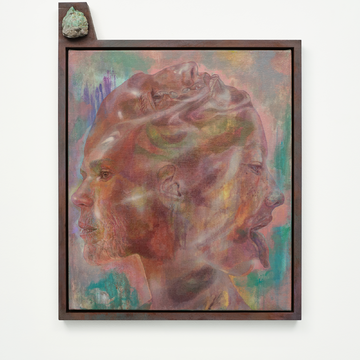
The gryllos is a motif from ancient Greek and Roman engraved gems: a hybrid creature composed of several heads, cut in intaglio. Koo fuses three faces, or three masks, into a single mass. The surface appears fired like terracotta, in tones where copper meets charred brown. Each face turns at a different angle, yet none stands apart; all are bound within one body.
Here the makeup artist’s experience returns to the canvas most directly. If makeup places another face on top of the skin, Gryllos gives form to a state in which several faces coexist without erasing one another. The terracotta-like surface recalls the materials of special effects makeup, such as hardening plaster and silicone, while also suggesting what remains after fire: fired clay, carbonized wood. The three faces may be read as three states of gender, three moments in time, or the many selves a single being holds at once.
Gryllos–Three-faced Aberration–First, 2026
Acrylic on canvas, 53 × 145 cm
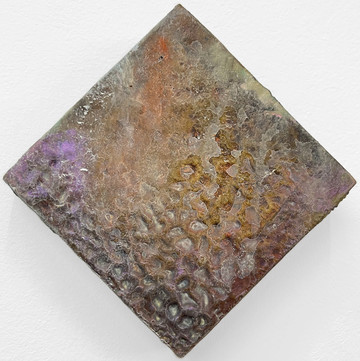
IV. Molt
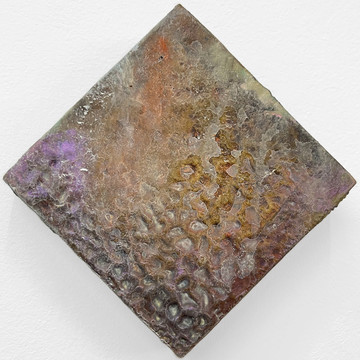
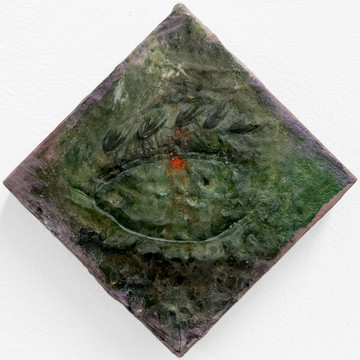
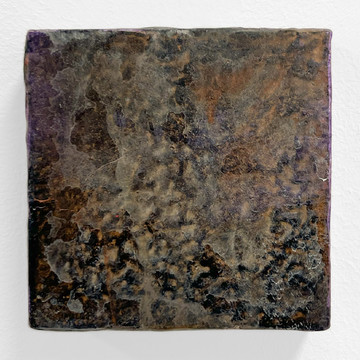
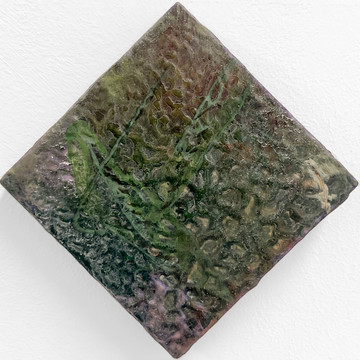
Where Molts places insect shells on human skin as an image, the Molt series (2026–) carries the shell into matter. Beginning with the skins and outer coverings of living creatures, the series explores how different materials meet to form new surfaces. The shells of pill bugs, beetles, and glass frogs are translated into painterly imagery and texture, while minerals, fossils, petrified wood, and prehistoric arrowheads are embedded in plaster panels, so that paint and object interfere with one another. Plaster, a material Koo knows intimately from special effects makeup, becomes the ground of the painting itself.
Many of these materials carry deep time. Fossils and petrified wood are bodies turned to stone; the arrowheads are traces of human hands from before recorded history. The shell here is no fixed boundary but a surface in constant transformation, altered by contact between different beings and materials. It is less a covering than a skin in the midst of being shed.
Molt series, 2026
Mixed media on plaster panel, 10 × 10 × 2 cm
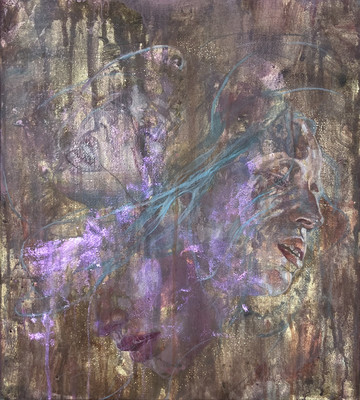
V. Gryllos–Three-faced Aberration–Second
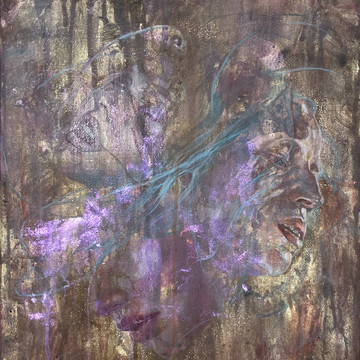
Gryllos–Three-faced Aberration–Second extends the fusion begun in the first work. The contours of different faces and bodies are layered, and colors and surfaces intermingle, capturing the moment when the features of distinct bodies collide and become a single hybrid being. Where the first work holds three faces within one mass, the second lingers on the instant of merging, when outlines still overlap and no single face has yet settled into place.
Gryllos–Three-faced Aberration–Second, 2026
Acrylic on canvas, 53 × 145 cm
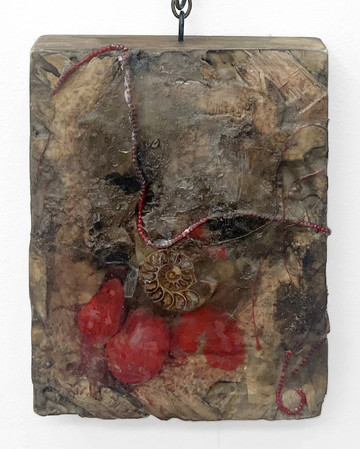
VI. Arisaema Amurense–First
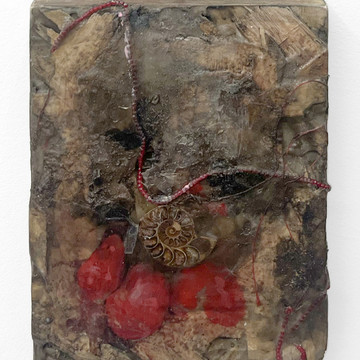
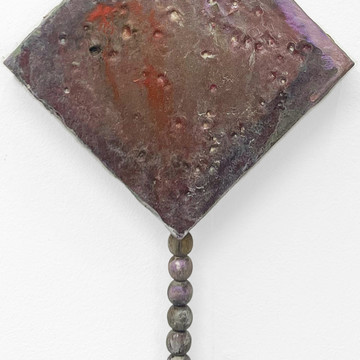
Arisaema amurense, known in Korean as cheonnamseong, is a plant native to Korea that bears vivid red berries yet is poisonous. [Plants of the genus Arisaema are also known to change sex over their lifetime, producing male flowers when young and small and female flowers once they have stored enough energy. In this, the plant quietly echoes the androgynous gods that run through Koo’s work.] Taking these qualities as a point of departure, Koo brings ammonites, thread and beads, different kinds of wood, and metal chains onto the painted surface. The materials collide and act upon one another, and the image emerges from that friction: an alluring surface that does not permit a light touch.
Arisaema Amurense–First, 2026
Acrylic on wood panel, threaded beads, larch wood, 17.85 × 13.7 × 3
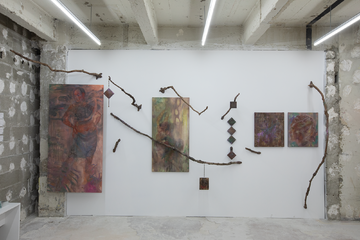
Yeonsumok Installation
Koo Jiun has long asked whether an artwork can function as a ritual, something that connects people and brings about change. More recently, rather than holding to the certainty of such a belief, she has turned her attention to the process itself: the way different beings meet, sense one another, respond, and change.
At the center of the installation, a yeonsumok tree grows out of the wall, with paintings and small sculptures gathered around it. Breaking through the wall, the tree reaches both upward and downward, supporting or crossing the paintings and establishing a new balance and tension in the space. This image of support comes from the common use of yeonsumok as a walking stick.
Around the tree are shells shed from bodies, stones that hold different times and natures, a Gryllos in which the forms of many beings are mixed, and a cheonnamseong, a plant that carries both allure and toxicity. Each is an independent presence, yet each shapes the forms and positions of the others; together they compose a single space.
Koo understands such encounters as a process of gameung and joeung, resonance and correspondence: different beings stir sensation in one another, respond, and gradually change. These relationships are neither necessarily harmonious nor stable. Support and collision, allure and threat coexist. The installation proposes a ritual space in which different beings continually act upon one another and are changed.