
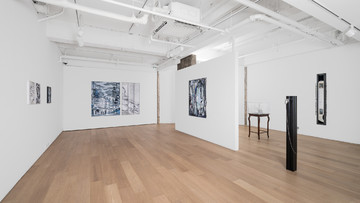
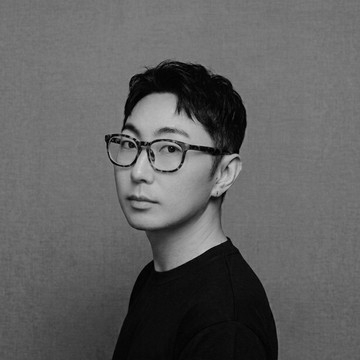
Dew Kim brings queer presence, religious iconography, imagination, and the sensibility of the digital age into intersection, unsettling fixed identities and normative systems of value. Growing up as the child of a pastor while coming into his own as queer led him to see the body as a ritual site of faith, resistance, desire, and transformation. Through sculpture, video, and performance, Kim examines how power operates through devotion, discipline, and desire, using BDSM aesthetics to explore dominance and submission, pain and pleasure. Religious iconography and popular culture converge in his work, where beauty and the grotesque, sublimity and humor, desire and belief collide and are reconfigured through new relationships. Fragments of the body, sexual desire, and religious oppression become autobiographical images in which the sacred and the violent coexist. Through these intersections, Kim explores forms of contemporary existence that resist reduction to a singular identity or system of value.
Dew Kim (b.1985) works across sculpture, installation, video, and performance. He received an MA in Sculpture from the Royal College of Art, London, and a BFA in Metalsmithing and Jewelry from Konkuk University. His work has been presented at documenta 15 (Kassel), Malta Biennale, Busan Biennale, the Italian Pavilion at Gwangju Biennale, MMCA (Seoul), Seoul Museum of Art, Art Sonje Center, and Para Site (Hong Kong). He has presented solo exhibitions at CR Collective, Alternative Space LOOP, Various Small Fires, out_sight, and Archive Bomm. He has participated in residencies at Künstlerhaus Bethanien (Berlin), ISCP (New York), SeMA Nanji, and MMCA Goyang. His work is held in the MMCA Government Art Bank, Sunpride Foundation (Hong Kong), The Here and There Collective (New York), and Seoul Metropolitan Government.
Dew Kim
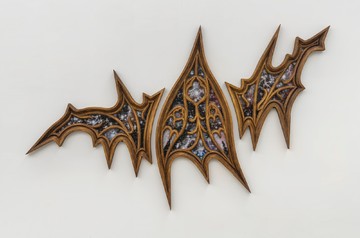
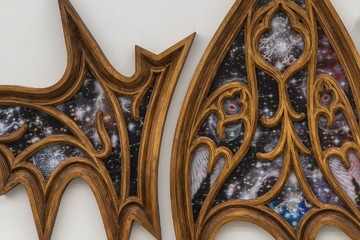
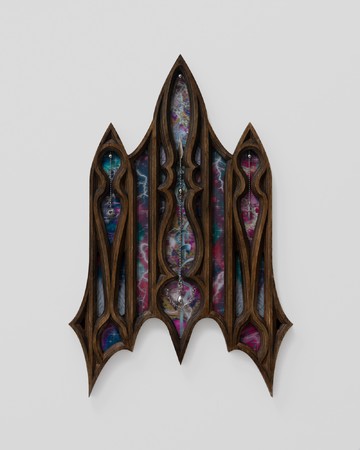
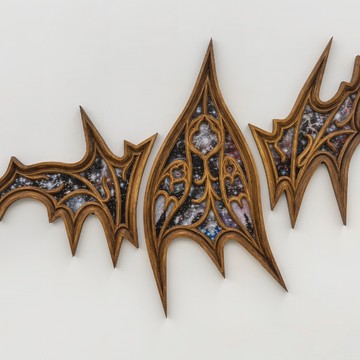
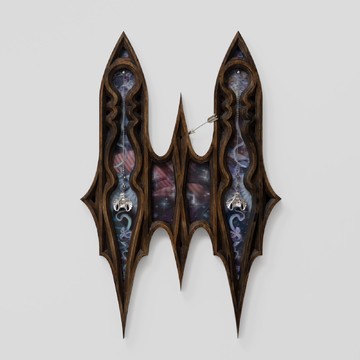
Cathedral in Flight, Under the Wounded Sky
2025
Mixed media with wood and lenticular
100x168x3.5 cm
Dew Kim, Cathedral in Flight, Under the Wounded Sky, 2025
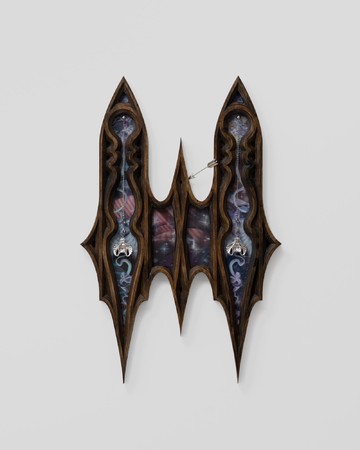
Dew Kim
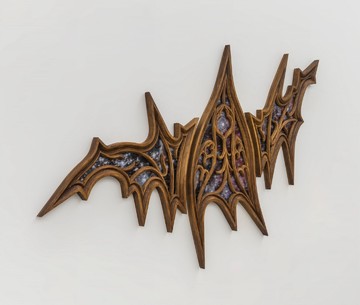
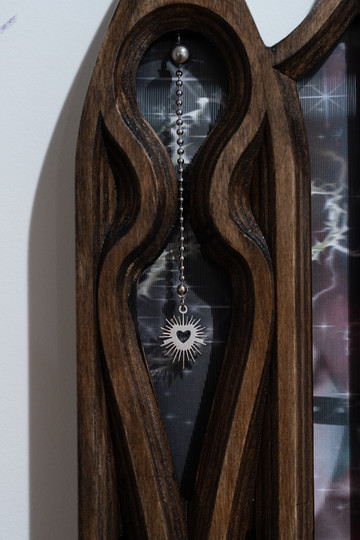
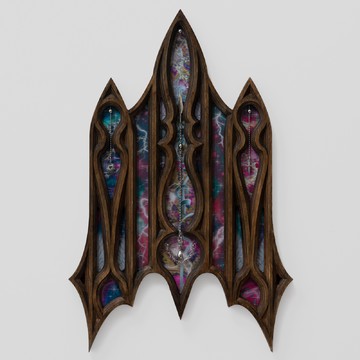
Pierced Grace 01
2026
Mixed media with wood, lenticular, and aluminum casting
58x38x3 cm
Dew Kim
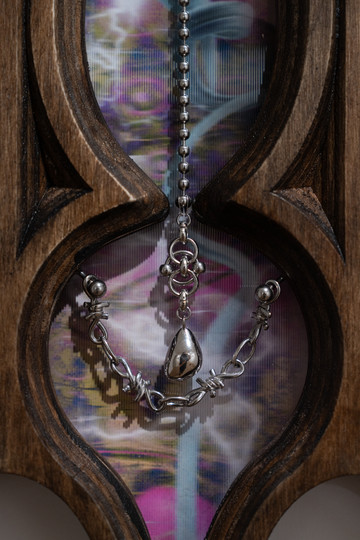
Pierced Grace 02
2026
Mixed media with wood, lenticular, and aluminum casting
56x37x3 cm
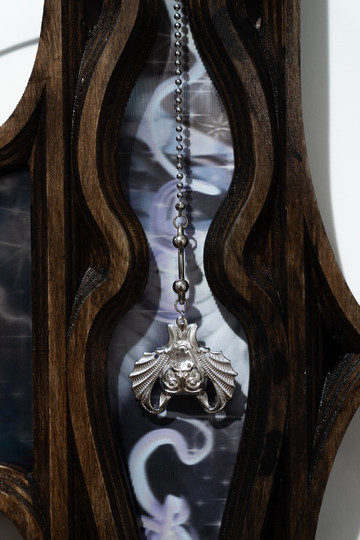
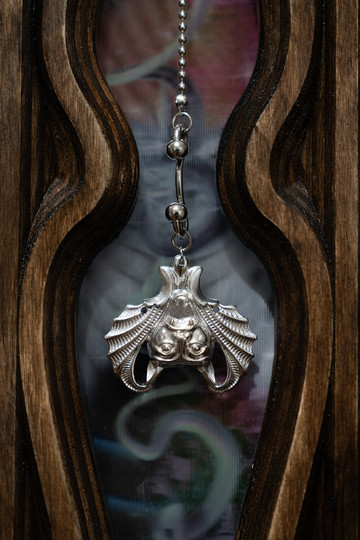
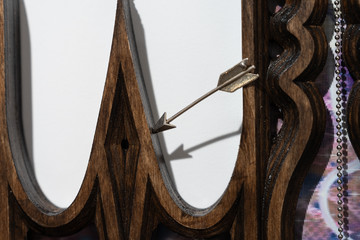
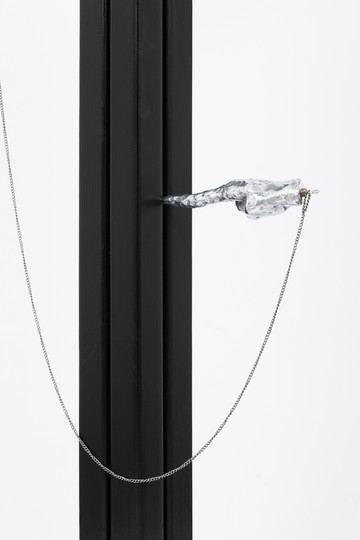
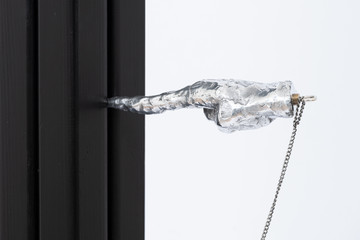
Pierced Grace 01 & 02 (2026) and Cathedral in Flight, Under the Wounded Sky (2025) are sculptural works that explore the complex relationships between religious architecture, the body, violence, and desire. Architectural elements reminiscent of Gothic cathedral spires and stained-glass windows are deconstructed and reassembled into forms that evoke both fragments of religious architecture and unfamiliar living organisms. The combination of wooden structures and lenticular images creates a visual space in which architectural forms and bodily imagery intersect and permeate one another.
Rooted in the artist’s experience of growing up in a Christian environment and navigating queer identity, these works examine the relationship between religious sacrifice and sadomasochistic desire. Just as pain and sacrifice may be understood as pathways towards salvation and transcendence within religious rituals, pain and submission within sadomasochism can be transformed into consensual acts that generate pleasure and desire. Across these different contexts, violence, sacrifice, pain, and pleasure become intricately entangled through the body, producing new meanings.
In these works, the cathedral is no longer a fixed architectural symbol of divine authority but is reconfigured as a fluid structure in which desire and suffering intersect. The lenticular images embedded within the structures shift with the viewer’s movement, layering religious iconography, bodily fragments, and imagery of sacrifice and violence within a shared visual space. Rather than presenting the sacred and the profane, oppression and liberation, or pain and pleasure as opposing concepts, the works reveal them as interconnected forces that continually permeate and transform one another, giving rise to new relationships.
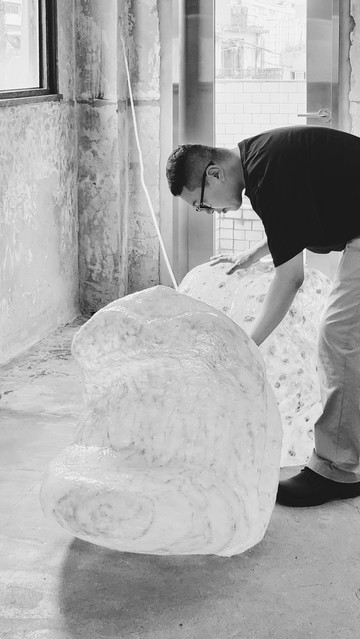
Kun Kang translates complex emotions rooted in personal experience into tactile two- and three-dimensional works. Combining materials with distinct properties—from yarn, feathers, wool, and resin to animal glue, calcium carbonate, wax, and pastel—he creates skin-like surfaces where softness and fragility coexist with sharpness and solidity. While anxiety and tension arising from circumstances beyond his control shaped his earlier works, his recent practice reflects a growing distance from himself as he modulates this inner turbulence. Scratched, covered, and re-exposed, the surfaces bear traces of forces that have passed through them, suggesting how the fragile resists collapse and maintains its form. Through emptiness and fullness, rupture and joining, collapse and endurance, tangled masses of memory and emotion crystallize into singular forms.
Kun Kang (b.1988, Seoul) received his DNAP from École européenne supérieure d’art de Bretagne, Rennes, and DNSEP from École nationale supérieure d’arts de Paris-Cergy. His solo exhibitions include Zeto Art, Galerie Vazieux, Youngeun Museum of Contemporary Art, and Suwon Art Space Gwanggyo, with group exhibitions at Fondation Villa Datris and Centre d’Art Contemporain de Meymac and Galerie Da-End. Selected for ARTAGON II, he received the Prix du Public at the Prix Dauphine pour l’Art Contemporain. His works are held in the collections of Fondation Villa Datris, Centre Artasia Paris, and Youngeun Museum of Contemporary Art.
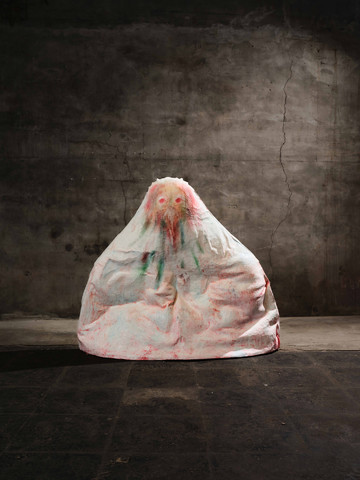
Kun Kang
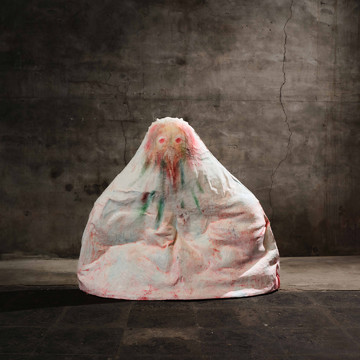
Dispparatus II
2026
Animal glue, calcium carbonate, fabric, mica powder, paraffin wax, polyurethane foam, soft pastel
116 × 35 x 93(h) cm
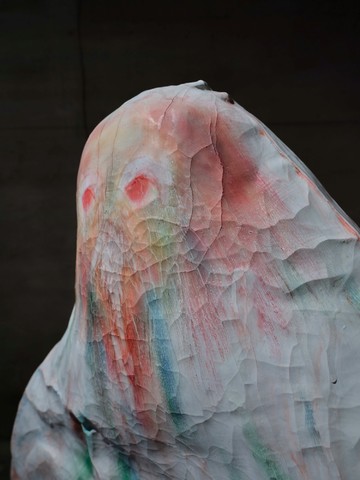
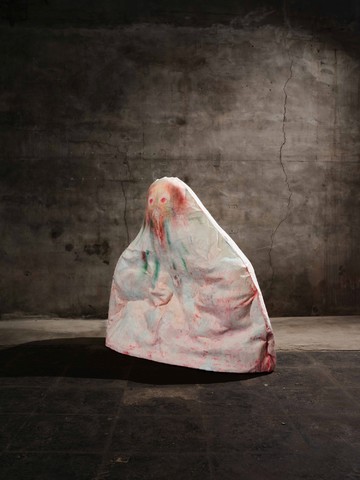
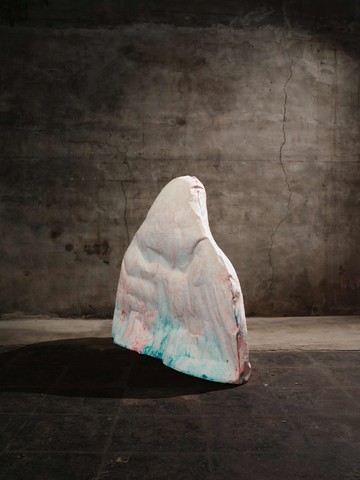
Through my sculptural practice, I explore the tension between the human body, the inner self, and the forces that act upon them from outside. The title Dispparatus comes from apparatus, meaning a device or instrument, a term also used in magic for devices that produce acts of disappearance and appearance. I added dis- to evoke disappearance, but here disappearance does not simply mean vanishing. It refers to the moment when one state disappears and another comes into view.
The hardened fabric surface recalls skin or a shell, carrying traces of cracking, pressure, and folding. Although the surface is fractured, it remains supported by an internal structure and continues to hold its form. Through this structure, which seems at once to collapse and endure, I consider a body and a form of existence that do not completely disappear after being acted upon, but remain in a different state. Emptiness and fullness, fracture and joining, collapse and endurance coexist within the work.
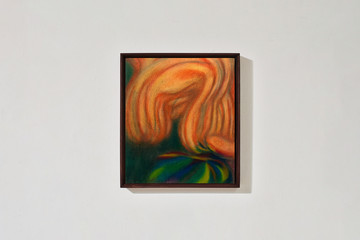
Kun Kang
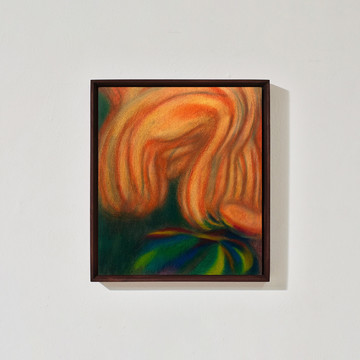
Will it be forgotten if it draws near
2026
Soft pastel on paper
with frame 50.2 × 57 cm
I imagine a body left without a self, and a mind released from the body. The desire to be free from the body exists alongside the contradiction that the self cannot exist without it. When the body and the self collide, what is wounded, and what begins to change? As that liberation draws near, can the mind and the inner self remain as they were?
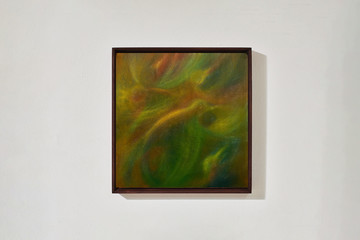
Kun Kang
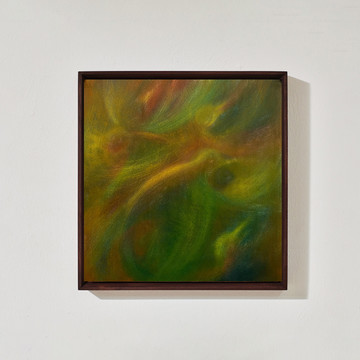
Even in the wind
2026
Soft pastel on paper
with frame 50.2 × 52 cm
Even when they are not visible, forces are still at work. In the face of an overwhelming force, one may lose the will to resist or surrender, confront it and move forward, or at times try to make use of it. I wanted these different responses to coexist within a single image, while asking myself what true liberation might mean to me. My process of scratching the surface and layering pastel over it also connects to the image itself, where different forces and states overlap within one scene.
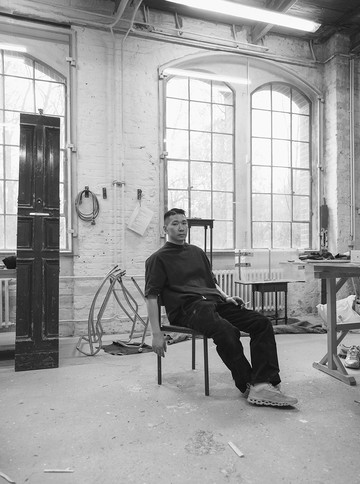
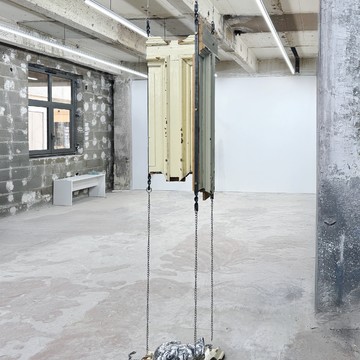
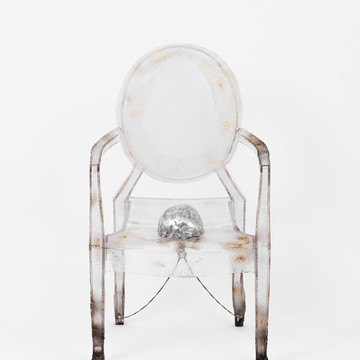
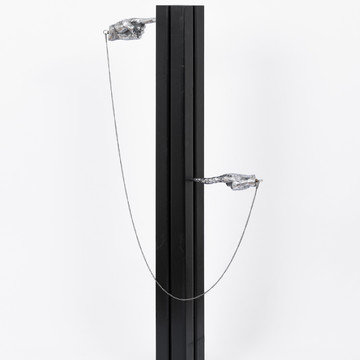
Shinoh Nam approaches architecture not as a fixed physical entity, but as a psychological and cultural space where time, memory, and individual and social experience accumulate. Working across sculpture, installation, and drawing, he brings old doors, windows, furniture, and architectural fragments into the present, combining them with newly fabricated elements. Removed from their original settings, these objects retain traces of time, while materials from different periods and cultures enter into new relationships, unsettling our perception of familiar objects and spaces. The presence of the body further blurs boundaries between architecture and individual existence, inside and outside, belonging and displacement. Angoisse Peur Mauvaise foi (2026) distills these concerns through a vintage European door and a body cast in aluminum. As passage and obstruction, belonging and displacement coexist, the title’s “anxiety, fear, and bad faith” evoke both a body compelled to navigate its position and the impulse to believe in a stable direction nonetheless. Through movement and choice, rupture and repetition, position and meaning remain in flux.
Shinoh Nam (b.1993) is based between Berlin and Seoul. He completed his Meisterschüler under Monica Bonvicini at Universität der Künste Berlin and studied Fine Art and Architecture at Kunstakademie Düsseldorf. His work has been shown at The Drawing Center (New York), Maison Clearing at Art Basel (Basel), Kunsthalle Dessau (Dessau), and Karma International (Zurich). He received the UdK Berlin Art Award and the Kunststiftung Perdita und Hans-Peter Kunze Award, and was shortlisted for the ARS VIVA Prize. His works are held in the Burger Collection (Hong Kong), Die Sammlung LBBW (Germany), and Krupa Art Foundation (Poland).
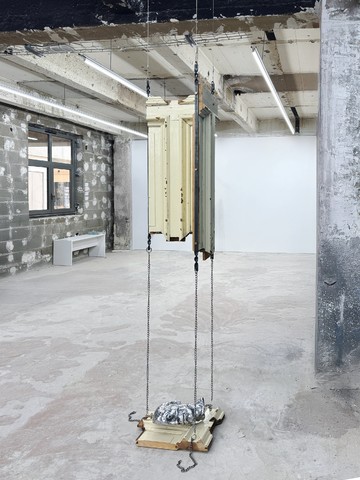
Shinoh Nam
Angoisse Peur Mauvaise foi
2026
1900s vintage door, steel, stainless steel, mirror-polished aluminum, brass
55 × 45 x 86(h) cm (Dimensions Variable)
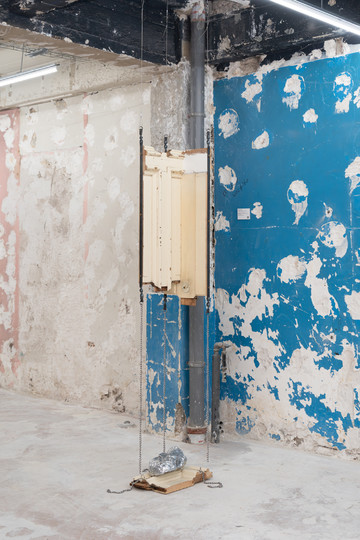
Angoisse Peur Mauvaise foi addresses the condition of a human being thrown into the world, attempting to locate oneself within uncertain circumstances. A door, once marking the boundary of a private and secure space, loses its original direction and function and becomes enclosed within a structure that appears solid but is, in fact, fragile. The figure inside tries to look outward through the door viewer, yet blocks the opening out of anxiety and distrust that the gaze from outside might return upon them. Desire and fear collide, while the door and the body remain separated from one another, revealing the contradiction of having to continually choose and assume one’s position within a world that offers no certainty.
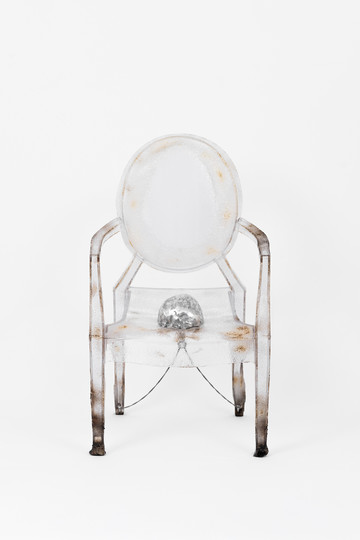
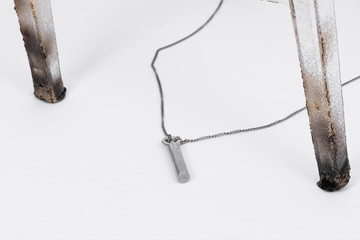
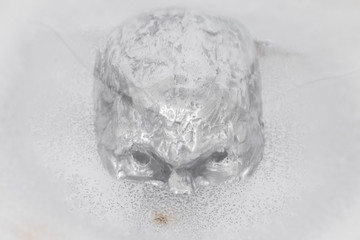
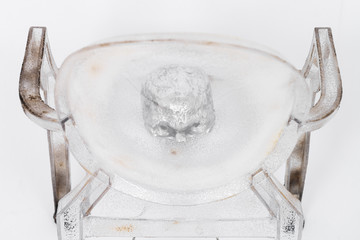
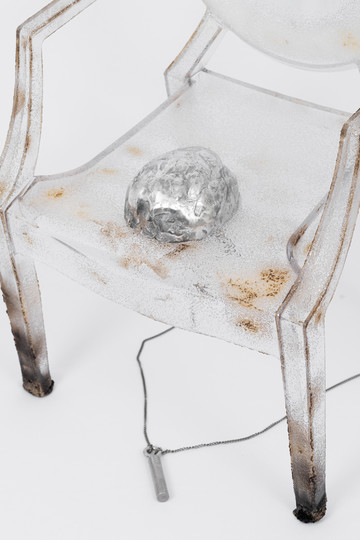
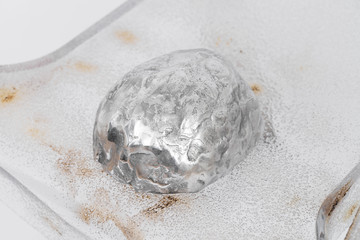
Shinoh Nam
With an Eternal Longing for the Day I Believe In to Reach Me
2026
artist-made ghost chair, stainless steel, steel, mirror-polished cast aluminum
50 x 43 x 91.5(h) cm
(*Not Presented at the Fair — On View at RANEE SEOUL)
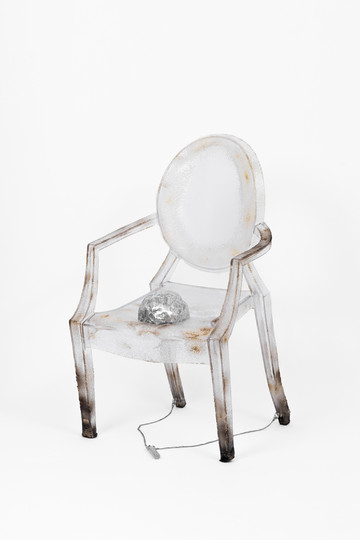
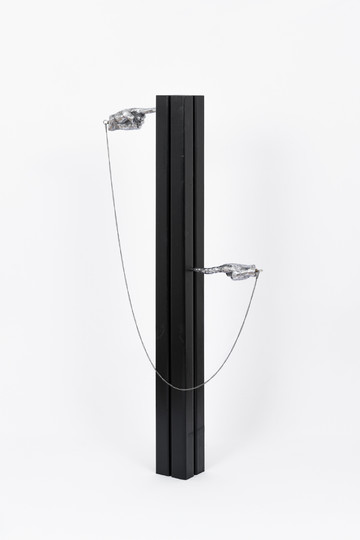
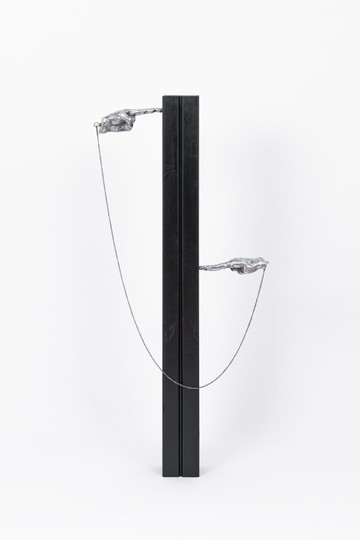
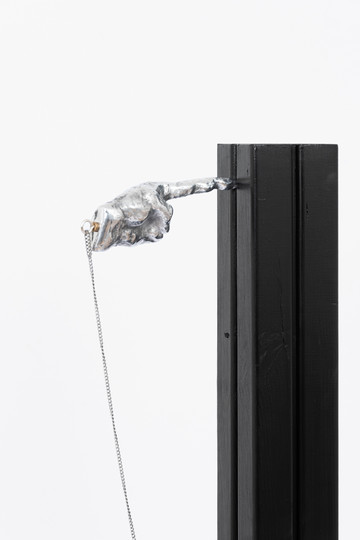
Shinoh Nam
Happy Is the One Who Believes at Least in Unbelief
2026
pressure-treated red pine, mirror-polished cast aluminum, steel, brass, urethane, stainless steel
54 x 12 x 125(h) cm
(*Not Presented at the Fair — On View at RANEE SEOUL)
Dew Kim
Cathedral in Flight, Under the Wounded Sky
Dew Kim
Pierced Grace 01
Dew Kim
Pierced Grace 02
Kun Kang
Dispparatus II
Kun Kang
Will it be forgotten if it draws near
Kun Kang
Even in the wind
Shinoh Nam
Angoisse Peur Mauvaise foi
Shinoh Nam
With an Eternal Longing for the Day I Believe In to Reach Me
Shinoh Nam
Happy Is the One Who Believes at Least in Unbelief