Kazuna Taguchi
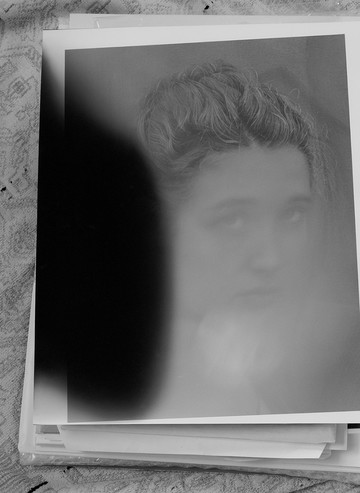
The eyes of Eurydice #45, 2019
Silver gelatin print
Edition 2/3
Image: 16.6 x 12.1 cm (6 ½ × 4 ¾ in.)
Sheet: 25.4 x 20.3 cm (10 × 8 in.)
Courtesy the artist and Radio Athènes
Kazuna Taguchi’s spectral, invariably black-and-white
analogue photographs reconfigure images of her own
paintings and sculptural fragments, as well as private
pictures, historical artworks, and found anonymous imagery.

Kazuna Taguchi
The eyes of Eurydice #13, 2020
Silver gelatin print
Edition 2/3
Image: 16.6 x 12.1 cm (6 ½ × 4 ¾ in.)
Sheet: 25.4 x 20.3 cm (10 × 8 in.)
Courtesy the artist and Radio Athènes
The Eyes of Eurydice, ongoing since 2019 is her most
extensive work cycle to date. Taguchi alludes to the
mythological figure of Eurydice, whom Orpheus was
unable to redeem for he dared a forbidden look at her
on their way back from the underworld.
Kazuna Taguchi
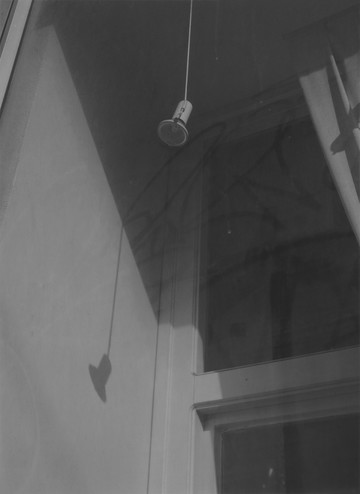
The eyes of Eurydice #14, 2019
Silver gelatin print
Edition 1/3
Image: 16.6 x 12.1 cm (6 ½ × 4 ¾ in.)
Sheet: 25.4 x 20.3 cm (10 × 8 in.)
Courtesy the artist and Radio Athènes
This photograph of an abandoned house in
Vienna’s 14th district was taken by the artist
from the street in the early morning.
Lukas Gschwandtner
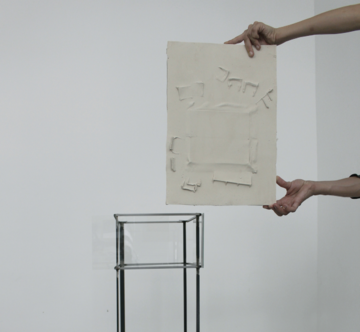
vitrine, möbel dinner (detail), 2026
Steel, plaster, glass, mirror
56 x 38 x 107 cm
Courtesy the artist and Radio Athènes
An interpretation of a “Perspektivenkasten”, a perspective
box cabinet, to view a gathering of absence. The internal
surface shows a dinner scene, while the external one shows
a cast fragment of a table dressed with a cloth. A hidden
plaster stucco fresco, viewed through a vanity mirror
acts like a portal that draws the viewer into the dinner.
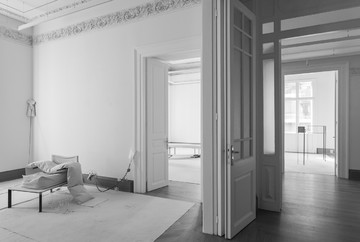
Lukas Gschwandtner
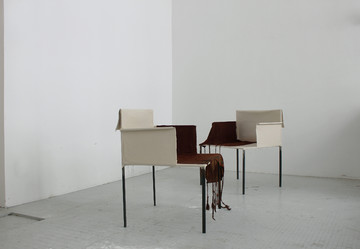
club chair twins (I & II), 2026
Fossilized textile (late 19th century), canvas, steel
56 x 64 x 80 cm (each)
Courtesy the artist and Radio Athènes
Translation of a club chair set. Canvas is pressed
onto metal frames. The chairs coexist with a shared,
but divided between them Middle Eastern textile from
the late 19th century. Frozen in its drape, the fabric
becomes an integrated fossil suggesting a human
absence. There is an echo of Aristophane’s speech
on Eros, in the Platonic dialogue Symposium.
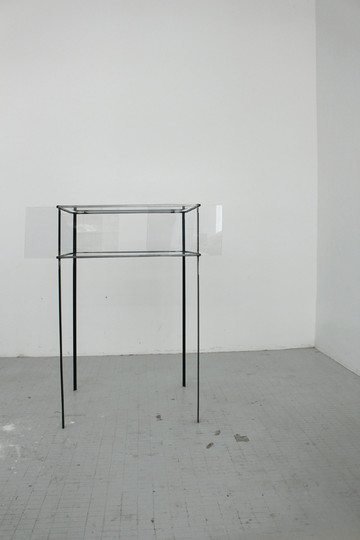
Lukas Gschwandtner
vitrine, narrenkastl [glass sibling of club chairs], 2026
Steel, sheets of glass
56 x 64 x 107 cm
Courtesy the artist and Radio Athènes
“Ins Narrenkastl schauen” dates back to the Middle Ages
and is an Austrian dialect expression for “staring into space.”
While seated, two people stare into an empty glass cabinet
that frames the person sitting opposite them. What they share
is the empty vessel in between them that is filled with nothing,
just their thoughts.