
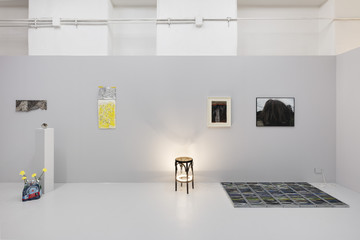
At Paris Internationale, Martina Simeti presents new works by Costanza Candeloro and RM Marco Pezzotta, two practices that trace, from different angles, the quiet politics of domestic labour and the codes through which taste and class are transmitted.
Candeloro’s collages and framed garments draw on nineteenth- and twentieth-century print culture to trace women’s unpaid labour, echoing the visual language of 1970s feminist militancy: fragments of text and image recomposed into sequences that read, at once, as archive and slogan.
RM Marco Pezzotta’s works are made in collaboration with his mother, Annamaria, whose crochet — a craft historically tied to working-class women’s domestic labour — becomes the material of sculptures resembling hard drives, preserving intimacy as memory. Drawing on Bourdieu’s notion of habitus, the works trace how taste, inherited and then displaced by education, becomes a site of belonging and estrangement.
Both practices turn craft, print and gesture passed down through family and history into material and form, giving shape to the overlooked labour of women.
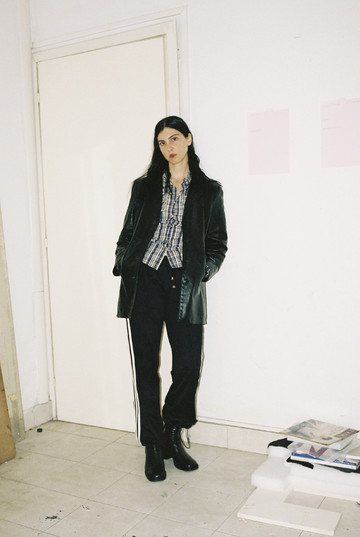
Costanza Candeloro (Bologna, 1990) graduated in 2014 from the Haute école d’art et de design in Geneva (HEAD). The artist now lives and works in Paris.
Costanza Candeloro employs writing as a generative element and research subject. Using deconstruction as a tool of enquiry, newly written or appropriated texts are transformed into words, signs and symbols and then declined in the form of sculptures, installations and performances, evolving into a continuous process of formation. Through a praxis of intuitive cognitive assimilation, aimed at making the original content disappear, Candeloro favours compositional elements and gestures along with different types of representation, crafted in a unique artistic approach.
Amongst her most recent solo shows: Neurologic, Eyleen Gallery, Marseille (2026), Different kinds of wants, Centre d’édition contemporaine, Geneva (2025), Present | Future, Artissima, Turin (2024), Tout le temps de vie est temps de travail, Sihl Delta, Zurich (2024), Possessed is The Style, Austellungsraum Friedensgasse, Zurich (2024), C&G at Istituto Svizzero Milan (2023), ENVY & GRATITUDE, Martina Simeti, Milan (2022), My Skin-care, My Strength, ICA Milano, Milan (2022), Sweet Days of Discipline, La Plage, Paris (2022). Recent group exhibitions include: Paroles, Paroles,
La synagogue de Delme, Delme (2026), RENAISSANCE, Museion, Bolzano (2024), Greetings, Galerie Hussenot, Paris (2023), Bodiesbodies, La Rada, Locarno (2023), Stages of Adulthood, Sittenwer Art Library and Material Archive, St. Gallen (2021), DEVOURED SPACES at Tunnel Tunnel (Lausanne) (2021), and was invited to open the RETROFUTURO project at the MACRO Museum of Contemporary Art in Rome in 2021. In 2024, Candeloro’s work was featured in a group show at Museion, Bolzano and in BRAINS, curated by Goton, Mimosa Echard, Aodhan Madden at Gaudel de Stampa, Paris.
In the series Tout le temps de vie est temps de travail (All of life’s time is working time), the artist draws on the history of two feminist organizations in Bologna: the Aemilia Ars cooperative, founded in 1889 by Lina Bianconcini Cavazza, and the publication Le Operaie della Casa (The Domestic Women Workers), published in 1975 by the International Feminist Collective.
Aemilia Ars focused on the production of lace and embroidery, allowing women to work from home and providing them with an income while they continued to manage their domestic responsibilities. The cooperative was organised through offices responsible for design, distribution and the collection of work.
Le Operaie della Casa examined the role of housewives in an Italian society that legitimised the subordination of women. The publication addressed unpaid domestic work as a form of exploitation and proposed its economic recognition as a means of improving women’s working and social conditions, supporting economic independence, equality and self-determination.
Using print-related reproduction and dissemination techniques as tools for rewriting and re-editing, Candeloro connects these two histories through the figure of the domestic woman worker. Lace motifs associated with Aemilia Ars are assembled with fragments from books and materials related to Le Operaie della Casa and transposed onto cotton using T-shirt printing techniques.
By drawing on the logic of slogans and reproduction through printing, the artist considers language as a tool of protest: a message carried on the body, shared and collectively embodied. Through these processes, Candeloro explores the links between publishing, poetry and feminism.
Candeloro is also the co-founder, with Francesca Ciccone, of Licit Illicit Bookshop, a project exploring the relationship between rarity and radicalism. Its catalogue includes publications on feminist theory, queer and postcolonial studies, anti-psychiatry, literature, poetry, and related fields.
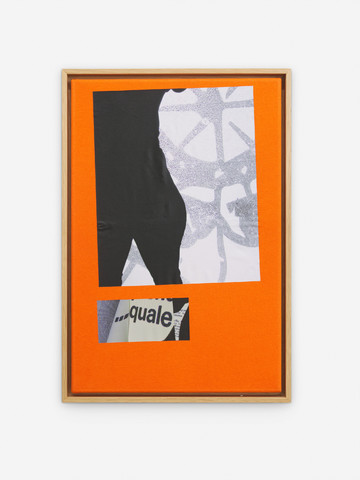
Costanza Candeloro, Tout le temps de vie est temps de travail, 2025
Cotton T-shirt, screen print, 64 × 44 × 6 cm
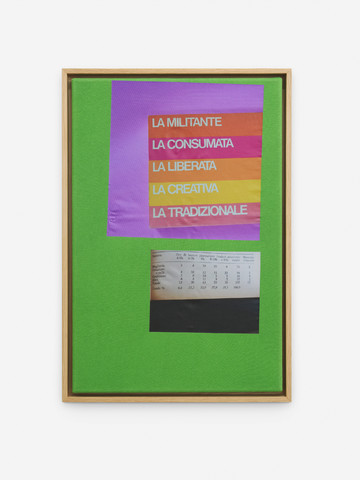
Costanza Candeloro, Tout le temps de vie est temps de travail, 2025
Cotton T-shirt, screen print, 64 × 44 × 6 cm
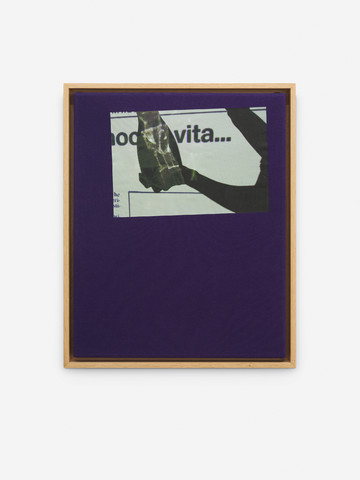
Costanza Candeloro, Tout le temps de vie est temps de travail, 2025
Cotton T-shirt, screen print, 54 × 44 × 1 cm
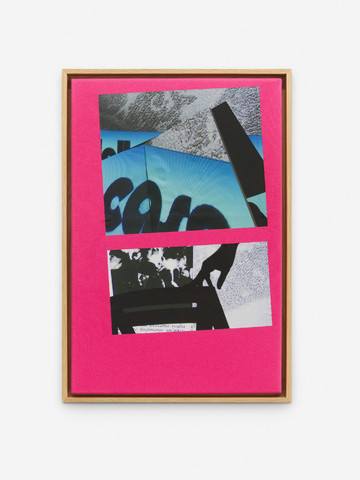
Costanza Candeloro, Tout le temps de vie est temps de travail, 2025
Cotton T-shirt, screen print, 64 × 44 × 6 cm
RM Marco Pezzotta is the third iteration of a project initiated in 2015 under the name Real Madrid, later shortened to RM. Originally conceived as a collaborative platform, RM has gradually developed into an individual practice, moving away from the blurred identity that characterized its beginnings. During the last decade, Pezzotta’s practice has focused on the becoming of identities and on states of illness in their relationship to language and wit. This third chapter marks a shift toward a practice engaging with the ambiguity of value, with class lonesomeness, comfort and, inevitably, with decay.
Solo exhibitions were held at Martina Simeti, Milan; Tunnel Tunnel, Geneva; Kunstmuseum St. Gallen; Auto Italia, London; CEC Centre d’Edition Contemporaine, Geneva; Swiss Institute, New York; Centre Culturel Suisse, Paris. Recently, their work has been included in group shows held at Museo Madre, Naples; Fondazione ICA Milano; Centre d’Art Contemporain, Geneva; Quadriennale Roma, Rome. RM received the Swiss Art Award in 2018 and 2023. In January 2026, RM’s work joined Geneva’s Plainpalais as part of Neon Parallax, a project bringing neon works into public space.In 2026, the first monograph, RM Decay, was published by Distanz Verlag.
RM Marco Pezzotta lives and works in Berlin.
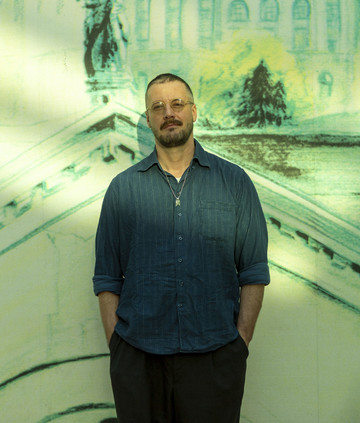
Pezzotta conceived this series of works specifically for the exhibition Yours Tastefully. The phrase plays with the conventions of English correspondence — Yours sincerely, Yours faithfully, Yours truly — replacing them with tastefully, meaning “with taste”. An incorrect formula, in other words, but one that already presupposes knowledge of the correct one. The détournement thus plays on a kind of awkwardness: the desire to conform to a convention while at the same time demonstrating an awareness of its rules. Like politeness, taste presupposes knowledge and mastery of certain codes, which in turn signal social belonging. The French sociologist Pierre Bourdieu showed that taste is not a natural or innate faculty, but a social construction shaped by one’s origins, education and accumulated cultural capital. What we like — in music, art, food or clothing — thus contributes to situating us within social space. If the tastes of the dominant classes appear natural, it is precisely because they are acquired so early and so deeply that they come to seem self-evident.
Following his recurring interest in the interdependence of bodies and in what it reveals about their permeability as well as their vulnerability, Marco Pezzotta explores his relationship with his parents and the role taste plays within it: that of a child who becomes an adult and, through access to a different education, learns a new language, acquires different codes and, with them, a different taste.
At the centre of these works is Pezzotta’s relationship with his mother, Annamaria. All the crocheted elements were made by her, extending a collaboration that began in 2022 and turning the works into the tangible result of an exchange between mother and son.
This form of crochet remains associated with a particular period and a particular style. I myself think of my grandmother, whose furniture was covered with crocheted doilies. Historically, crochet was practised by the working classes, particularly by women, as a domestic activity and a modest source of income. In the twentieth century, it was also adopted by haute couture houses such as Chanel and Schiaparelli. Today, this distinction is less clear-cut. Crochet can be claimed both as a form of popular craft heritage and as a legitimate artistic medium. It nevertheless remains a craft that was long rendered invisible because of its association with domestic labour and women’s work. In this case, the forms crocheted by Annamaria were not made to fulfil their usual function of protecting a table. They are neither curtains nor clothes. They are above all signs: of a skill that Annamaria has mastered, of a possible origin, but also of an exchange between a mother and her son, the tangible result of an interaction between two people.
Pressed between two transparent discs that preserve the object, these sculptures, slightly recessed vertically into the wall, evoke hard drives preserving a memory. The glass also recalls the function of display cases, behind which objects are placed for protection. It removes them from everyday use and lends them a greater sense of preciousness. Through this artistic collaboration, crochet thus crosses the boundary between domestic craft and art.
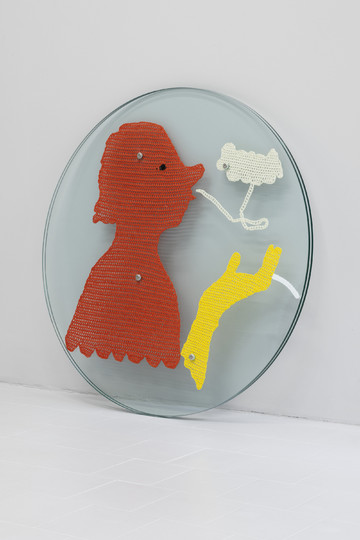
RM Marco Pezzotta, Ends Sunday, 2026
Glass, steel, crocheted cotton, Ø 82 cm
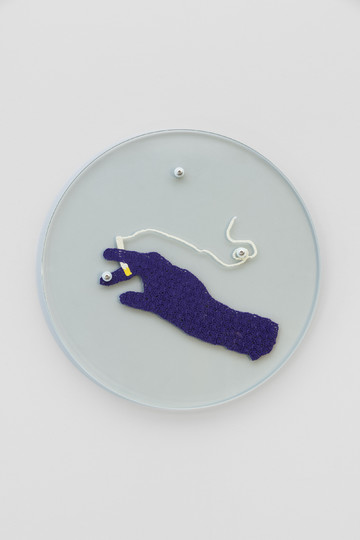
RM Marco Pezzotta, Merit, 2026
Glass, steel, crocheted cotton, Ø 45 cm
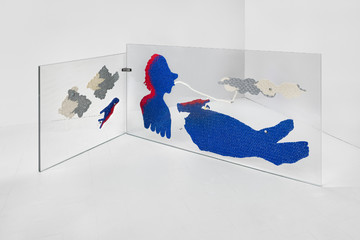
RM Marco Pezzotta, Little fête at the foot, 2026
Glass, steel, crocheted cotton, 155 × 82 × 76 cm
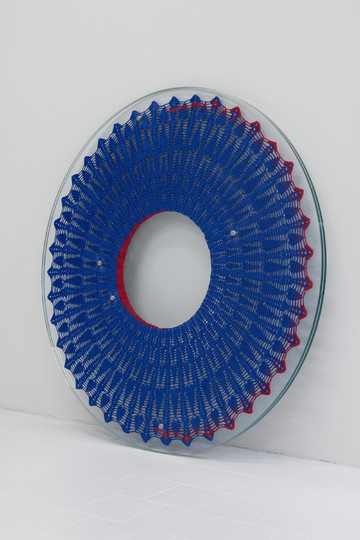
RM Marco Pezzotta, The lips shaping another small o” 2026
Glass, steel, crocheted cotton, Ø 97 cm
Untilted is a series of A4 crayon drawings on pastel-coloured paper.
The title plays with the idea of keeping things straight, or more literally, “not tilted”, reflecting the way Marco Pezzotta considers drawing as a form of support or counterbalance to his sculptural practice.
The series includes drawings developed from screenshots taken from his 2024 animated video Two Actions United in One Frame, alongside a group of mannequin portraits.
In both cases, Pezzotta reverses the usual process through which an image comes into being: characters originally created for the video are transformed into portraits and brought back to the status of studies, while the anonymous, human-like figures encountered in shop windows become subjects in their own right.
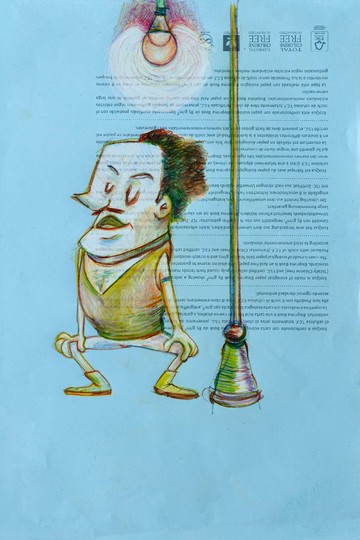
RM Marco Pezzotta, Untilted, 2025
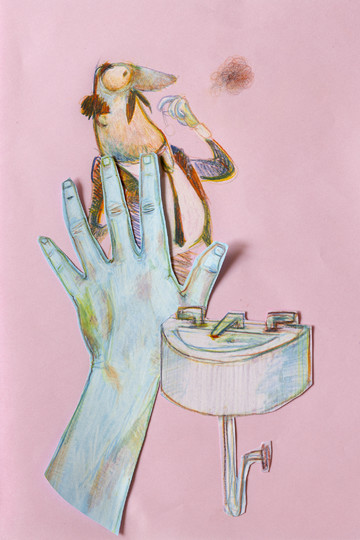
RM Marco Pezzotta, Untilted, 2025
Crayon on paper, 29,5 × 21,7 cm
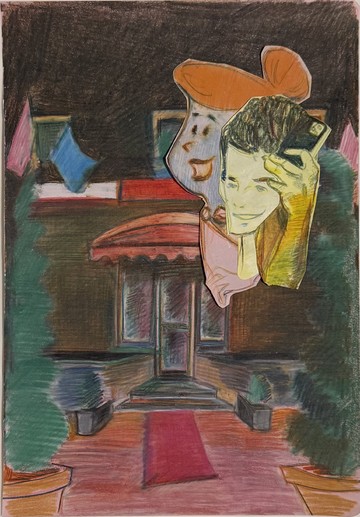
RM Marco Pezzotta, Untilted, 2025
Crayon on paper, 29,5 × 21,7 cm
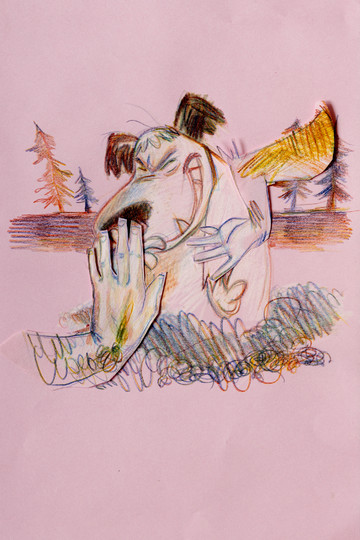
RM Marco Pezzotta, Untilted, 2025
Crayon on paper, 29,5 × 21,7 cm
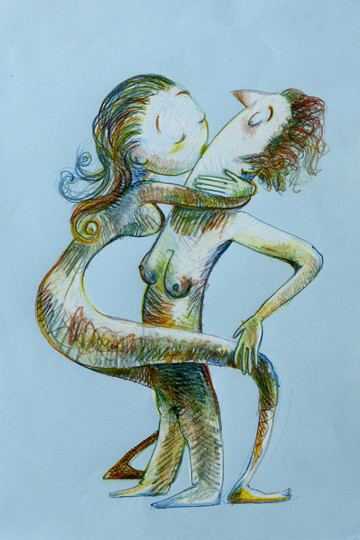
RM Marco Pezzotta, Untilted, 2025
Crayon on paper, 29,5 × 21,7 cm